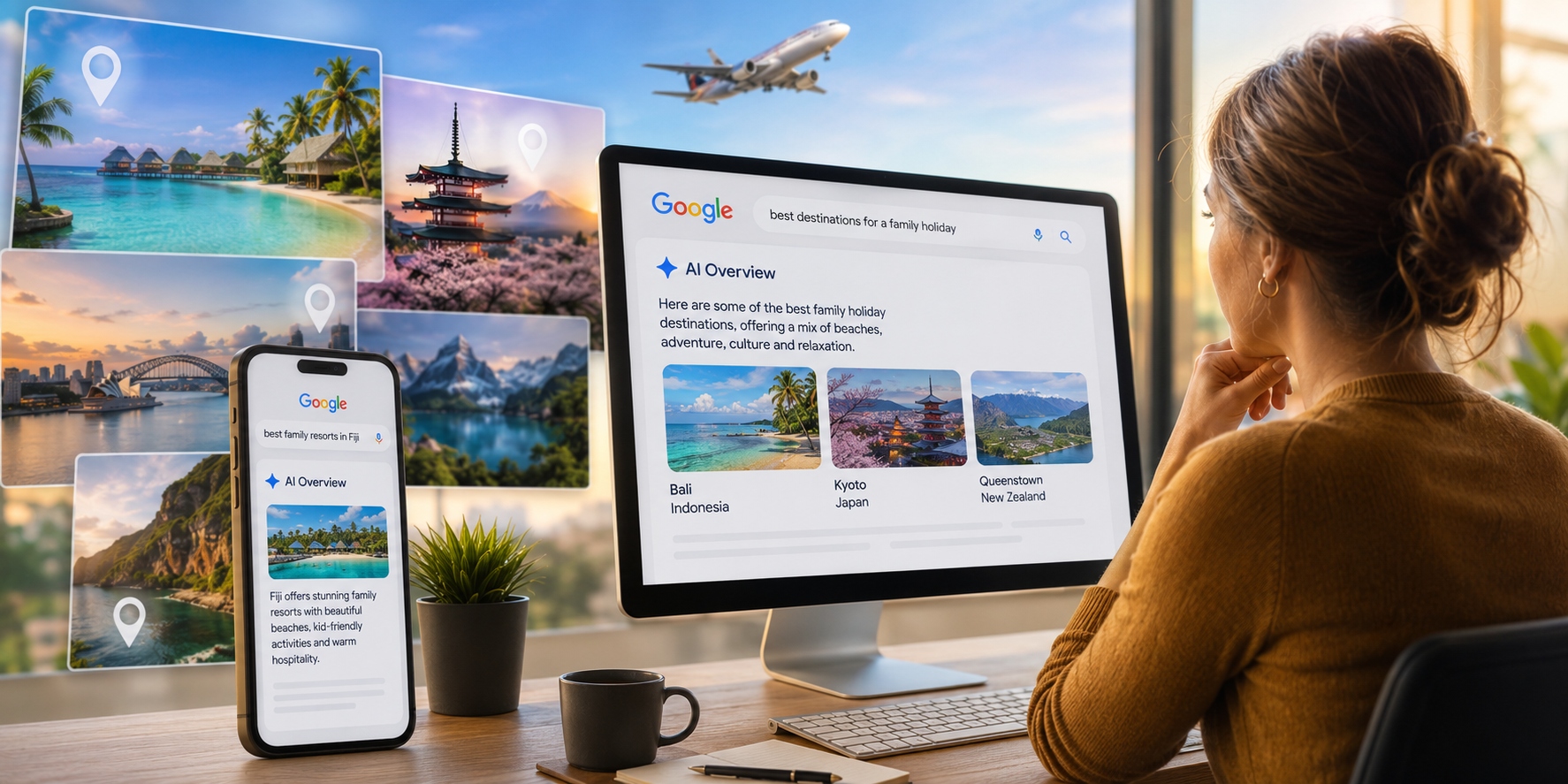
The way travellers research and book holidays is undergoing one of its biggest shifts since the rise of online travel agencies, and Google’s expanding use of artificial intelligence is already reshaping how consumers find travel information. The change is happening not gradually, but at speed.
The rollout of AI-generated search results, known as AI Overviews, has transformed the customer journey by delivering direct answers to travel queries without requiring users to click through to websites. In 2025, AI Overviews grew from appearing in around 6–7% of global searches at the start of the year to a peak of nearly 25% by mid-year, while in the US market specifically, some measurements placed the figure as high as 60% of searches by November. Travel is one of the most heavily affected categories, with Google now answering specific queries like “things to do in [city]” and “family friendly activities in [destination]” directly within results.
For travel businesses, destinations and publishers, the implications are not theoretical. They are already measurable.
Instead of searching for “best family resorts in Fiji” and browsing multiple websites, travellers now receive a detailed AI-generated summary that compares destinations, accommodation options and travel advice in seconds. The consequence for website traffic has been severe. A study by Seer Interactive, published in late 2025, found that organic click-through rates plummeted 61%, from 1.76% to 0.61%, for queries with AI Overviews, while paid click-through rates crashed 68%. Zero-click searches — where users receive their answer without clicking through to any website — now account for around 60% of all queries in the US, up from approximately 49% in 2019, when SparkToro first rigorously quantified the phenomenon.
Google has also moved well beyond simple summaries. The company now offers a full planning workspace called Canvas inside its AI Mode, which generates day-by-day itineraries and holds them in an editable side panel alongside flights, hotels and Maps details. Users can transition seamlessly from AI Overviews to conversational trip planning on mobile without leaving the search environment. Additional features include AI-powered flight deal finders, hotel price drop alerts, and Gemini-powered review summaries in Maps.
 The development raises urgent questions about how travel companies attract customers in an increasingly AI-driven landscape.
For decades, travel businesses invested heavily in search engine optimisation, content marketing and paid search campaigns to drive traffic to their websites. AI-generated search results have disrupted that model. Tour operators, tourism boards and travel advisors may need to fundamentally rethink how they position content. However, there is a clear survival path emerging. Brands that are cited within AI Overviews earn 35% more organic clicks and 91% more paid clicks than those that are not. The goal is no longer simply to rank. It is to be the source the AI draws from.
While some sectors of the industry view AI as a threat, others see opportunity. Travel advisors have long argued that personalised service, destination knowledge and complex itinerary planning cannot easily be replicated by technology. As travellers are presented with more AI-generated recommendations, the role of the advisor may become increasingly focused on interpretation, validation and customisation. Consumers can receive suggestions from an AI tool, but many will still seek reassurance from a human expert before committing to a significant travel purchase. For complex itineraries, multi-country journeys and premium travel experiences, advisors may be well placed to bridge the gap between automated recommendations and real-world expertise.
For Australian businesses, the stakes are particularly high. Research from BCG found that only 17% of Australian travellers are currently using AI tools for travel planning, compared to 50–65% of travellers from markets like China, India and Indonesia. That gap represents both a vulnerability and an opportunity.
Qantas Group CEO Vanessa Hudson signalled the industry’s direction in late 2025, saying that
“technology and AI is critical to lifting the customer experience at every part of the journey, from booking to inflight and baggage collection,”
as the airline announced a new Product Innovation Centre in Adelaide projected to employ more than 420 technology workers over three years.
The travel industry has adapted to major technological changes before, from the emergence of online booking platforms to the rise of social media and mobile commerce. But the pace and scale of Google’s AI expansion makes this shift harder to absorb gradually. Booking Holdings CEO Glenn Fogel has described the AI transformation of travel as among the most significant the industry has seen since the advent of the internet, calling it an era where generative AI is
“redefining how people will experience the world.”
The data is unambiguous. The way travellers discover destinations, compare products and plan trips has already changed.
For travel businesses, the question is no longer whether AI will influence the customer journey, or even when. It is whether the industry can adapt quickly enough to keep up with a transformation already well underway.