
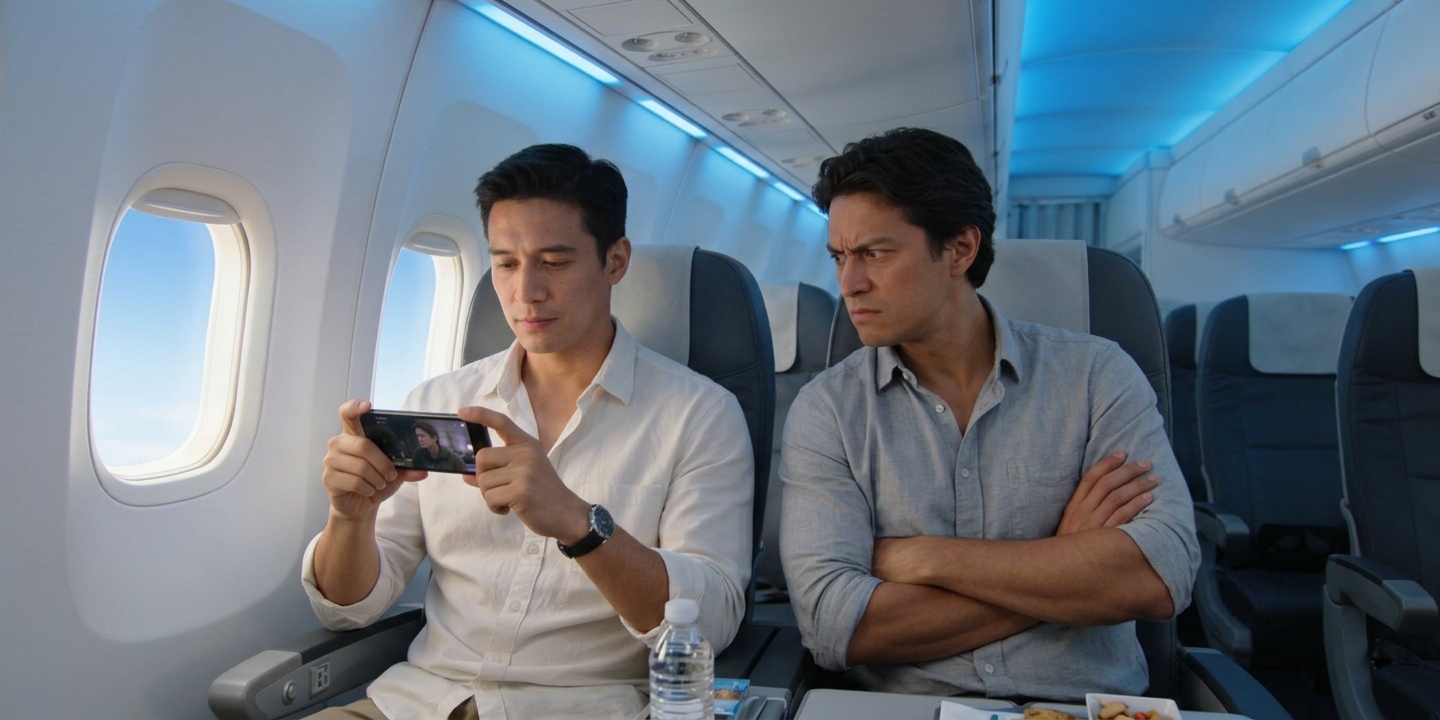
United Airlines has become the first major carrier to turn an unwritten etiquette rule into a hard line policy, giving crew the power to remove and even ban passengers who refuse to use headphones when playing audio on board.
United has updated its contract of carriage to add a new reason a traveller can be denied boarding or taken off a flight.
Anyone who plays videos, music or other audio through their device speakers and refuses to use headphones after being instructed by crew can now be treated like a disruptive passenger and refused transport in future.
The rule sits alongside more familiar offences such as threatening behaviour or ignoring safety directions.
Crucially, the policy does not target what you watch or listen to, but how you listen. Passengers can still stream movies, scroll TikTok or play games on their own devices, but they must use headphones or earbuds so the sound does not spill into the cabin. Travellers who claim they do not have headphones will reportedly be offered a basic pair on board, removing the main excuse for playing content aloud.
United says it has always expected passengers to use headphones and that the change simply formalises long standing cabin courtesy. The move also coincides with the roll out of faster inflight Wi fi, which has made constant streaming more common, and with growing frustration about people watching short form videos at full volume in tight economy cabins. For flight attendants, bringing the rule into the fine print gives clearer backing when they ask someone to turn the sound down.
So far, other big airlines have not followed United’s lead. Large US and European carriers, as well as Gulf and Asia Pacific airlines, generally frame headphone use as expected behaviour rather than a condition of carriage. Crew can and do ask travellers to turn off loud audio under broader “disturbance” or “disruptive behaviour” clauses, but there is no separate line in their rulebooks that singles out headphone use in the way United’s update does.
Low cost European players such as Ryanair and easyJet also focus on when electronic devices can be used, rather than spelling out penalties for listening without headphones.
The result is that United now sits out on its own as the airline where failing to plug in your earbuds can, at least in theory, lead all the way to a ban.
For most travellers this will never become an issue, because the vast majority already use headphones as a matter of courtesy. But the policy sends a clear message to those who insist on sharing their playlist with the whole cabin.
For frequent flyers and travel agents, the change is a reminder that soft etiquette norms can quickly be written into formal policy when enough passengers complain.
The question now is whether other airlines decide to copy United’s tough stance, or continue to rely on gentle nudges and common sense to keep the cabin quiet.





