
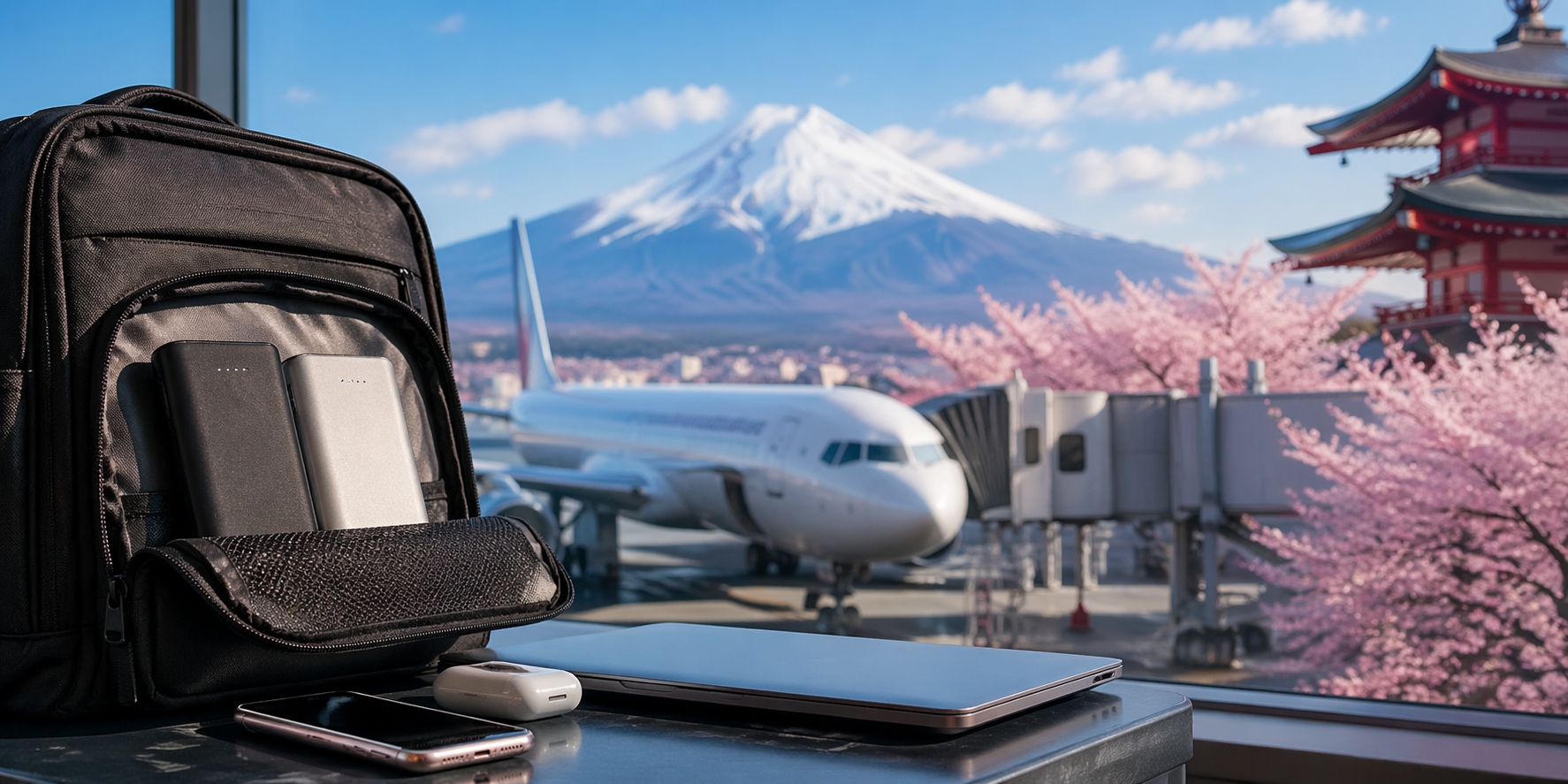
If you have clients flying to or through Japan, there is something important they need to know before they pack their bags.
New rules governing the use of power banks on flights came into effect today, April 24, as mandated by Japan’s Ministry of Land, Infrastructure, Transport and Tourism. The changes apply to all flights departing from, arriving in or operating within Japan, regardless of which airline your clients are travelling with.
The rules are straightforward but represent a significant shift from what many travellers are used to.
Each passenger may now carry a maximum of two power banks in their carry-on luggage. Each device must have a capacity of 160 watt-hours or less. Power banks remain prohibited in checked baggage, as has always been the case.
The biggest change is what happens once your clients are on board. Using a power bank to charge any device during the flight is now banned. Charging the power bank itself onboard is also prohibited. That means no topping up phones, tablets or laptops mid-flight using a portable charger, even if the aircraft has USB sockets available.
Power banks must also be kept within reach during the flight, not stored in overhead compartments or other storage areas.
What This Means In Practice
For many travellers, particularly those on long-haul flights where seat power is not guaranteed, this is a meaningful inconvenience. The advice to pass on to clients is simple: charge everything fully before boarding.
Most standard consumer power banks fall well within the 160Wh capacity limit. A typical 20,000mAh power bank sits at around 74Wh, so the majority of clients will not have an issue with capacity. However, larger units designed to charge laptops may exceed the threshold and should be checked before travel.
The rules apply equally to Japan Airlines, ANA and all international carriers operating in and out of Japanese airports. Clients travelling on connecting services through Tokyo or Osaka should also be aware, as transit passengers are covered by the same regulations.
Non-compliance carries serious consequences. Passengers who breach the rules face fines of up to one million yen, roughly $9,000 Australian dollars, or up to two years imprisonment under Japan’s aviation safety laws.
Why Japan Has Acted Now
The changes follow a series of battery-related incidents on aircraft across the Asia-Pacific region, including a notable fire caused by a power bank on an Air Busan flight in South Korea in January 2025. Japan’s move aligns with international standards set by the International Civil Aviation Organization and mirrors similar restrictions already introduced by a number of major airlines.
Japan is expecting around 40 million visitors in 2026, making it one of the world’s most popular destinations this year and a market that remains critically important for Australian travel agents.
Getting your clients across these rules before they travel will save them a nasty surprise at the departure gate.
The key messages to share are simple. Bring no more than two power banks. Keep them under 160Wh. Put them in your carry-on, not your checked bags. And charge everything before you board, because once you are in the air, the power bank stays in your bag.
Power Bank Rules: What Your Clients Need To Know By Airline
- Singapore Airlines — max two power banks under 100Wh, no in-flight use, from April 15, 2026
- Malaysia Airlines — no in-flight use or charging, power banks must be kept within reach and out of overhead bins, from April 1, 2025
- Qatar Airways — max two power banks under 100Wh, no in-flight use, aligned with ICAO standard
- Emirates — max one power bank under 100Wh, no in-flight use, must be switched off and stored in a protective case
- Etihad — max one power bank under 100Wh, no in-flight use, must be switched off and stored in a protective case
- British Airways — max two power banks under 100Wh, no in-flight charging, aligned with ICAO standard
- Qantas — max two power banks under 160Wh, no in-flight use, from December 15, 2025
- Jetstar — max two power banks under 160Wh, no in-flight use, from December 15, 2025
- Virgin Australia — max two power banks under 100Wh, no in-flight use, from December 1, 2025
- Fiji Airways — no in-flight use, power banks must be stored in seat pocket rather than overhead bins, from January 19, 2026
- Scoot — max two power banks, no in-flight use, from April 2025
- Thai Airways — max two power banks, no in-flight use, from March 27, 2026
- Air Canada, Delta and United — subject to the ICAO global standard of max two power banks per passenger and no in-flight charging on international flights. Passengers should confirm current policy directly with their carrier before travelling
- Mainland China carriers — max two power banks under 100Wh, no in-flight use. Power banks must carry an official Chinese 3C certification mark. Most internationally purchased power banks will not have this mark and risk confiscation at security
As power bank rules are evolving rapidly and individual airline policies may vary, travellers should always check directly with their airline before departing.





