I must confess I was never much of an academic at school.
Sport was my passion while book-learning lessons were regarded as an inconvenience between sweaty pursuits.
That was apart from history. For some reason the daring deeds of rulers, explorers and visionaries resonated with me, along with the study of various ancient civilisations.
So it was that on arriving in Graaff-Reinet, the fourth oldest town in South Africa, a chord was immediately struck.
Founded in 1786 deep in the Great Karoo, the town appears frozen in time, a place where fortune-seekers and prospectors once roamed and travellers have stopped to rest for more than two centuries.
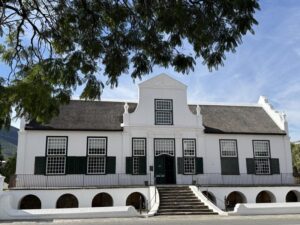 White-washed Cape Dutch homes line broad jacaranda shaded streets, church spires rise above the dusty streets and there’s a slice of history on every corner.
But this is no sleepy museum piece (although the town is home to a remarkable collection of said establishments). Graaff-Reinet has plenty of modern touches and a heartbeat that keeps it in step with the 21st century.
These days the town relies on tourism, game farming and traditional stock like Merino sheep and angora goats, which give mohair.
It sits inside a bend of the Sundays River, almost entirely surrounded by the rugged landscapes of the Camdeboo region.
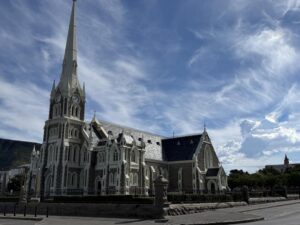
At the heart of town stands the towering Dutch Reformed Church, a dramatic structure inspired by Salisbury Cathedral in England. The striking exterior is matched by an equally impressive interior, with a massive organ, beautiful stained glass windows and a commanding pulpit.
 Around it are more than 200 heritage buildings, antique stores, art galleries and Karoo-style guesthouses that seem purpose built for long afternoons and slow travel.
A walking tour with a local guide gave us a fascinating insight into the life and times of the town, including a visit to the Graaff-Reinet Club, the second oldest social club in South Africa.
You can almost smell the history as you walk through the bar area and study the hilarious cartoon prints of the members who have graced it’s rooms. We also saw the bullet holes in the bar – a result of some over exuberant celebrations at the end of the Boer War.
We also visited Reinet House, a Cape Dutch parsonage built between 1805 and 1812. Originally a home for the clergy, it now stands as a premier cultural landmark, housing a collection that spans centuries.
Yet the true star of Graaff-Reinet lies just 14 kilometres outside town.
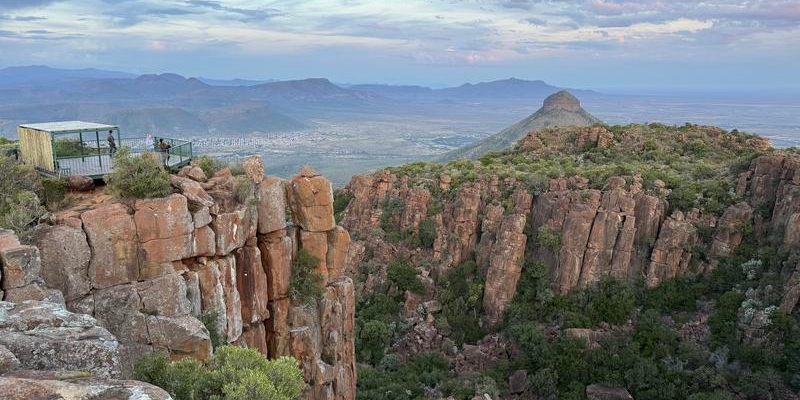
A short drive into Camdeboo National Park leads to one of the country’s most spectacular natural wonders, the Valley of Desolation.
And what an apt name it is.
This is the kind of place that stops conversations mid-sentence. Massive dolerite columns rise dramatically from the valley floor, some towering 120 metres high, sculpted by volcanic activity and erosion over millions of years.
The cliffs appear almost otherworldly, especially at sunset when the rocks glow burnt orange against the endless plains of the Karoo.
The surrounding national park is home to kudu, buffalo, springbok and the endangered Cape Mountain zebra, along with more than 220 bird species.
We arrived just as the sun started to dip behind the cliffs, climbing frantically like excited schoolchildren in a bid to catch the great show in all its glory.
Standing at the lookout point, the world suddenly feels enormous. The plains stretch all the way to distant mountain ranges, interrupted only by winding roads and scattered farms.
Sadly, we just didn’t make it in time to see the spectacular sunset we so desperately craved – an over-officious gate attendant robbing us of several precious minutes – yet it was still an incredible experience.
The place was haunting, beautiful and strangely calming all at once.
In an age of over tourism and crowded bucket list destinations, Graaff-Reinet offers something increasingly rare: space.
Space to think, to breathe and to reconnect with the raw beauty of travel itself.
Editor’s Footnote: The town was re-named Robert Sobukwe Town in February in honour of the anti-apartheid revolutionary, who was born and is buried here. The decision has split the town’s residents and a legal challenge is reportedly pending.
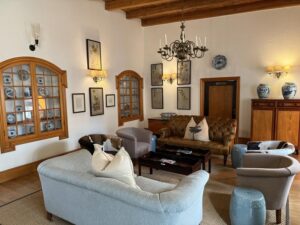 Where To Stay
If Graaff-Reinet is the crown of the region, then the Drostdy Hotel is it’s sparkling jewel.
Perfectly positioned in the heart of the conurbation, the 48-room Drostdy was originally constructed in 1804 as the administrative seat for the local magistrate and was designed by the renowned architect Louis Thibault.
Over two centuries, it has evolved from a residency to a Victorian-era hotel and finally into a five-star, pet-friendly sanctuary that honours every layer of its evolution.
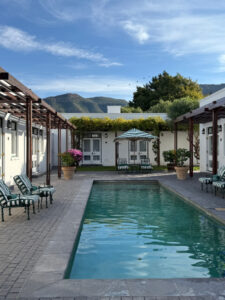 We spent a night at the Drostdy and I was immediately taken with the place, with its memorabilia-packed rooms, uber comfortable accommodation and excellent fare.
I also loved the colourful frontage of some of the rooms, similar in style yet slightly more muted to the Malay area of Cape Town.
With its quaint furniture and fittings, my room reminded me of a cottage in the Cotswolds. The bathroom was large and functional, and the roomy bed afforded an extremely comfortable night’s sleep.
The facilities also include a couple of pools, Africology Spa and De Camdeboo Restaurant, which uses locally sourced ingredients, including the famous Karoo lamb.
Guests can also explore the on-site Imibala Gallery, featuring a diverse collection of artworks created by local artists, each piece carrying its own story and cultural significance.
“It’s an honour to preserve the legacy of the property and the town,” says Tebello Polisane-Casper, General Manager of Drostdy Hotel.
“We believe that luxury in a heritage setting is, first and foremost, about authenticity.
“Yes, we work to ensure guests enjoy the modern refinements but we’re mindful of maintaining the sense that being here is being part of a 200-year-old story.”