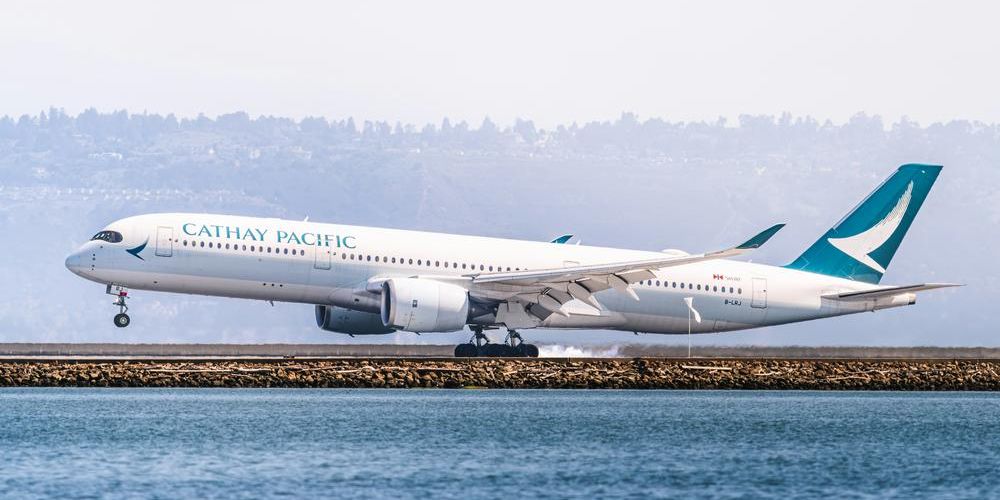
A leading aviation lawyer has raised concerns over Cathay Pacific’s explanation about an incident that injured passengers over the weekend.
Ten people travelling from Brisbane to Hong Kong were injured, with the lawyer comparing it to the May 2024 Singapore Airlines turbulence accident.
Peter Carter, Director of Carter Capner Law, has represented airline passengers who have suffered severe injuries caused by turbulence and similar events for more than two decades, including those on Singapore Airlines Flight 321 that plunged in similar circumstances in 2024, killing one person and injuring more than 70.
“Cathay said its aircraft encountered a weather system that appeared with ‘little warning’, much like the initial explanation by Singapore Airlines, which claimed its accident was caused by unforeseeable ‘clear air turbulence’,” he said.
“However aircrews in both events would surely have received forecasts indicating the likelihood of thunderstorms on their planned route and ought to have been hypervigilant while transiting places of known convective activity.”
Mr Carter said Cathay’s explanation may prove to be as misplaced as that of Singapore Airlines, whose initial description of “clear air turbulence” was debunked only last week after the investigation found the accident was caused by flying too close to thunderstorms.
“Pilots are trained to stay well distant from storms because aircraft can be severely affected several thousands of feet above a thunderstorm cell and up to 20 miles laterally,” he said.
“A further investigation will be needed for the Cathay flight to determine exactly what happened – what weather was forecast; how close were the storms; how quickly did the aircrew react?”
He said turbulence events expose passengers to massive G force changes within milliseconds.
“They don’t just float around the cabin in negative G, they are being flung with enormous force up and then down, hence the devastating injuries that result,” Mr Carter explained.
“My clients tell me that when a plane suddenly drops, it’s the most terrifying moment of their lives, with many believing they are about to die.
“Passengers in that category may have permanent suffering at work and in their personal lives, and even those who remain seated will struggle to ever fly again.”
He said passengers are entitled to compensation depending on the extent of their injury.
“Even if the airline is not at fault, the Montréal 1999 Convention enables passengers to claim up to $260,000 for proven losses like medical expenses, loss of amenities of life and income loss for proven bodily injury.
“The airline must also pay a higher amount unless it proves the accident was not due to its negligence or that of its pilots or engineers, so in that respect there is no longer a limit on compensation.
“All passengers on the Cathay Pacific flight irrespective of where they live, are able to claim.”
As well as holding a private pilot’s licence, Mr Carter is a long-standing member of the Aviation Law Association of Australia and New Zealand and a member of the Lawyer-Pilot Bar Association (USA), and indicated he is investigating a claim for passengers aboard Cathay Pacific flight 156.
Carter Capner Law also acted for passengers and crew on LATAM Airlines Flight 800 which plunged suddenly between Sydney and Auckland in 2024, and QANTAS Flight 72 that plunged twice between Singapore and Perth in 2008.