Airlines continue to find new ways to monetise their products and to put a brand name on every new idea for differentiation.
Business Plus is the latest example: a premium tier of larger, more private suites in the front row of the business class cabin, sold as a supplement on top of the fare.
For years, frequent flyers and ‘travel hackers’ have advocated booking the front or bulkhead row of business class to get more space and privacy.
These seats often came with additional legroom or width. Airlines have seen the trend and monetised it.
Air New Zealand’s business premier luxe, United’s Polaris studio, Oman Air’s business studio and Thai Airways’ new front-row business plus suites all follow this model.
Lufthansa is the extreme example. Its Allegris business class offers bulkhead business suites, a private double suite, extra space seats and an extra-long bed option, many of them for an additional fee.
It’s personalisation on steroids and an overly complicated seat range that most travellers don’t want.
The growth of business plus could finally spell the end of first class, which is largely used as an aspirational marketing tool above all else.
 Oman Air (above) retired first class in 2024 in favour of business studio, citing changing consumer trends and diminishing demand.
Thai Airways is following suit, phasing out first class entirely and introducing a front-row business plus offering.
Etihad has taken a different approach and is technically retaining first class – but the format is changing dramatically and moving to a much smaller footprint.
There is an opportunity for airlines to still offer larger seating while streamlining their service offering across cabins, as several business plus products already show.
Demand for premium travel continues to grow
Premium leisure travel is booming as asset values have increased since COVID. Travel continues to outperform other seemingly discretionary spending.
In fact, we would argue that many travellers no longer view travel as a discretionary or optional purchase at all.
According to IATA’s 2025 World Air Transport Statistics, 109.7 million passengers travelled internationally in business and first class in 2025, up 4.5% on the previous year.
Flat Beds, our specialist agency for business class and first class airfares, has seen business class bookings rise more than 20% year-on-year.
In a world where everything seems to be shrinking, more people are looking to make their journey as important as the destination.
 The opportunity for travel advisors
Advisors are increasingly being asked to sell more for less. Clients face more choice and more friction than ever and they’ve lost the joy of selecting a better seat without a charge.
Airlines are focused on ancillary revenue over keeping things simple and chargeable or differentiated seating in business class is another example of this. This is where our value as advisors comes in.
The main benefit for advisors who know these seat concepts is service differentiation.
Knowing which airlines offer them, on which aircraft and at what cost shows your knowledge and creates opportunities to add comfort to a client’s journey, which can aid customer retention.
When to recommend business plus
These seat upgrades are a nice-to-have rather than a must-do.
They are great as a splurge for a special occasion such as an anniversary or wedding, or as a form of ‘aspirational luxury’ for clients who might otherwise seek out an airline with a dedicated first class cabin.
Occasionally, these seats may also be available via bid upgrade, letting clients bid lower when they’re not set on the added onboard comfort.
If the add-on price is reasonable, they’re certainly worth considering, depending on the airline.
For Australian travellers, Oman Air’s business studio is a standout. It keeps the footprint of the airline’s former first class cabin but sits much closer to business class on price, and as a oneworld member, Oman Air offers Qantas Points and Status Credits throughout the journey.
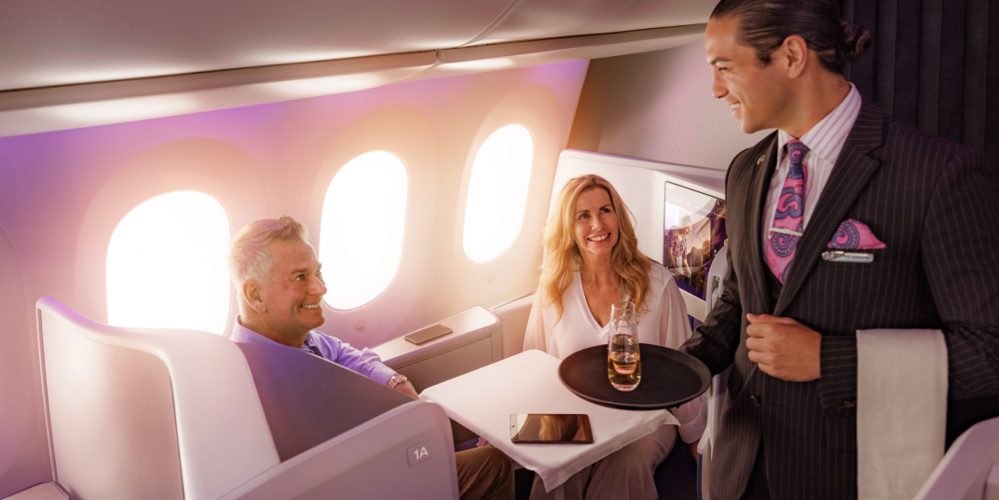
Air New Zealand’s business premier luxe, with a sliding privacy door, a dedicated guest seat and no footwell, is another worth knowing as its Boeing 787 retrofit program continues.
Comfort will continue to matter more as flights get longer.
With Qantas’ Project Sunrise set to launch non-stop flights from Sydney to London and New York by 2028, journeys of up to 22 hours will soon be a reality.
For advisors, knowing what sits in the front row of the business class cabin is quickly becoming as important as knowing the cabin itself.