Aussies travelling to the U.S. have been advised to check for potential disruption to their flights following the weekend shutdown of America’s airspace.
More than 15,000 flights were cancelled across the country after a nationwide air traffic control failure that stranded 1.5 million travellers.
Triggered by a communications outage, the disruption forced the Federal Aviation Administration (FAA) to ground flights for more than four hours on Friday, sparking travel chaos from coast to coast.
The impact was felt at major airports from New York and Boston to Chicago, Atlanta, Dallas and Los Angeles, with thousands of passengers stranded, missed connections and departure boards filling with cancellations.
The scale of the shutdown was highlighted by its place in U.S. aviation history, with the FAA having ordered a nationwide grounding of departing flights only twice before.
The first came on September 11, 2001, following the terrorist attacks, when all aircraft were ordered out of the skies.
The second occurred in January 2023, when a computer failure affecting the system used to distribute safety notices to pilots forced the FAA to temporarily suspend domestic departures for around 90 minutes.
The knock-on effect continued into Saturday when more than 6,400 flights were cancelled and a further 8,000 delayed across the country as airlines battled to get aircraft and crew back into position following Friday’s disruption.
United Airlines temporarily grounded its flights at Chicago O’Hare Airport with Delta Air Lines doing the same at New York’s LaGuardia Airport as congestion and gate availability created further operational headaches.
With delays extending into Sunday, the Australian Travel Industry Association advised Aussies heading Stateside to contact their travel agent, tour operator or airline for the latest advice.
“This is a developing situation and there will be knock-on impacts,” said Dean Long, ATIA CEO.
Sean Duffy, US Transportation Secretary, blamed the initial failure on ageing air traffic control technology, which was overwhelmed during work to upgrade communications equipment.
The problem reportedly began when a router malfunctioned during the replacement of older copper wiring with fibre optic technology, triggering instability across communications networks used by air traffic controllers.
The failure affected 17 of the country’s 22 en-route air traffic control centres, disrupting radar feeds and communications between controllers and pilots.
Officials stressed there was no evidence of a cyberattack or deliberate interference, with the FAA ordering the ground stop as a precautionary measure to protect passenger safety.
The incident has renewed concerns about the state of America’s ageing air traffic control infrastructure, with Mr Duffy calling for $US50 billion in funding to modernise the system.
Airlines urged passengers to check their flight status before heading to airports, warning that further delays and cancellations remained likely throughout the weekend.
The disruption also prompted concerns about the flow-on impact for international services, with overseas aviation authorities warning passengers travelling to and from the U.S. to expect possible schedule changes.
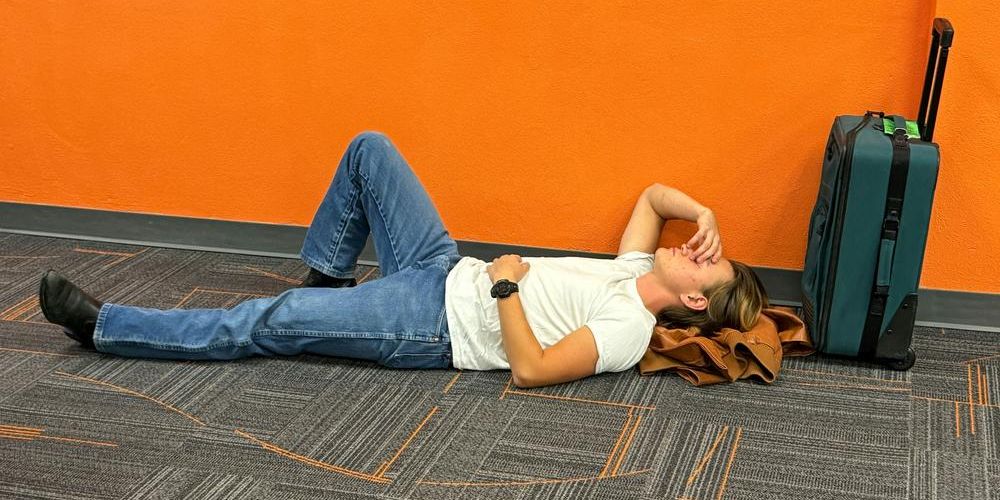
Above: Simple Plan singer Pierre Bouvier performing on a delayed flight