There are some destinations that feel so remote they almost don’t seem real until you get there.
Arctic Bay in Nunavut is one of them. In fact it barely seemed real even when I was there.
I first met Annah Fambisai, Marketing Manager at Destination Nunavut, at Rendez-vous Canada in 2024. Two years later, after one too many conversations about the Arctic, I found myself flying from Ottawa to Iqaluit before boarding a tiny propeller plane north to Arctic Bay.
From the moment we left Iqaluit, the landscape below became entirely white. Not “wintery” white. Just endless ice, frozen inlets and snow covered mountains stretching to the horizon.
On the plane behind me I overheard a man explaining that he and his teenage son were travelling to Arctic Bay to hunt a polar bear.
That probably should have been my first clue that this was going to be unlike any trip I’d ever done.
Arctic Bay Adventures, a community owned Inuit tourism company in Nunavut, operates floe edge safaris each spring on Admiralty Inlet.
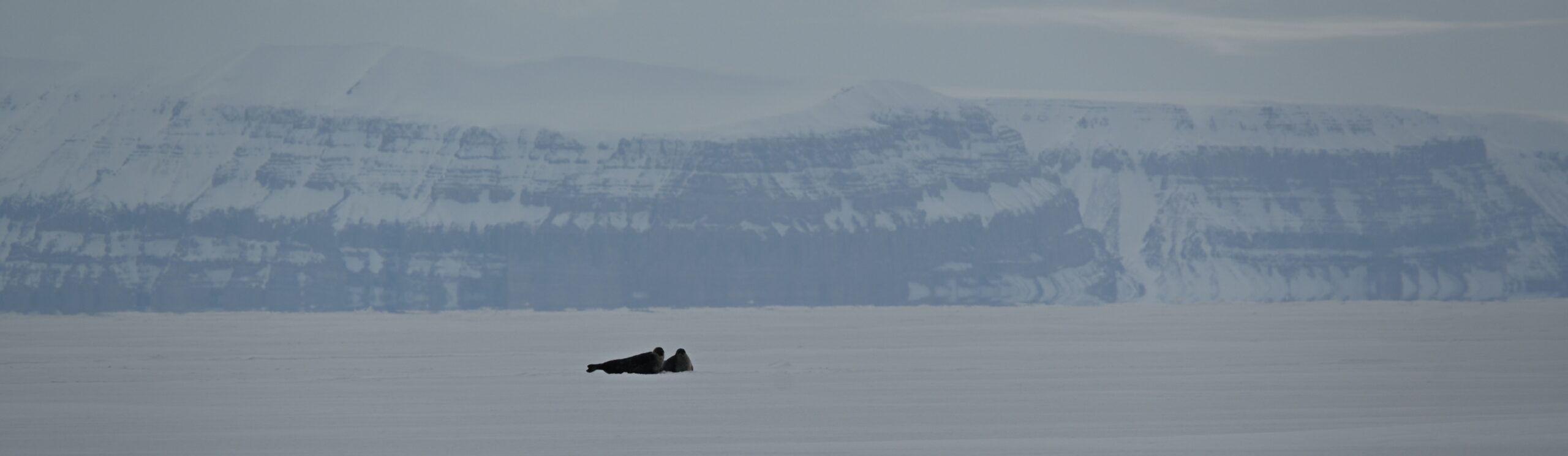
The floe edge forms where solid sea ice meets open water and attracts Arctic wildlife including seals, beluga whales, narwhals and polar bears.
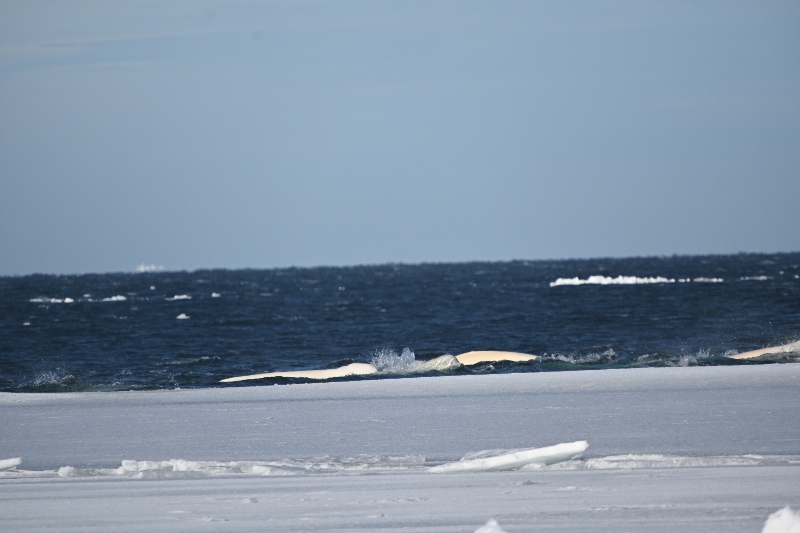 Beluga Whales at the floe edge
My idea of an ice floe safari (prior to my trip) was a short ride to the expansive floe edge then relaxing at the edge of the Arctic Ocean in deck chairs, casually watching narwhals glide past.
The reality was considerably more involved.
Before we even left Arctic Bay, there were layers to put on, gear to organise and weather conditions to assess. The floe edge isn’t somewhere you casually visit. Reaching it depends entirely on ice conditions, wind and visibility and even then, there are no guarantees.
Before heading out onto the ice I was given a brief safety orientation.
The main instructions were simple: listen to your guides and don’t wander off.
There was also some discussion on ways to survive a polar bear attack, involving elbows, hugs and gloves down a bear’s throat. I hoped very much never to test any of them personally.
Despite the casual delivery, the risks were very real. Camp was monitored around the clock by a bear monitor and whenever we travelled out onto the ice, one of the guides carried a rifle in case we encountered a polar bear too close for comfort.
The experience begins by snowmobile and qamutiik, a traditional Inuit sled pulled behind the skidoo.
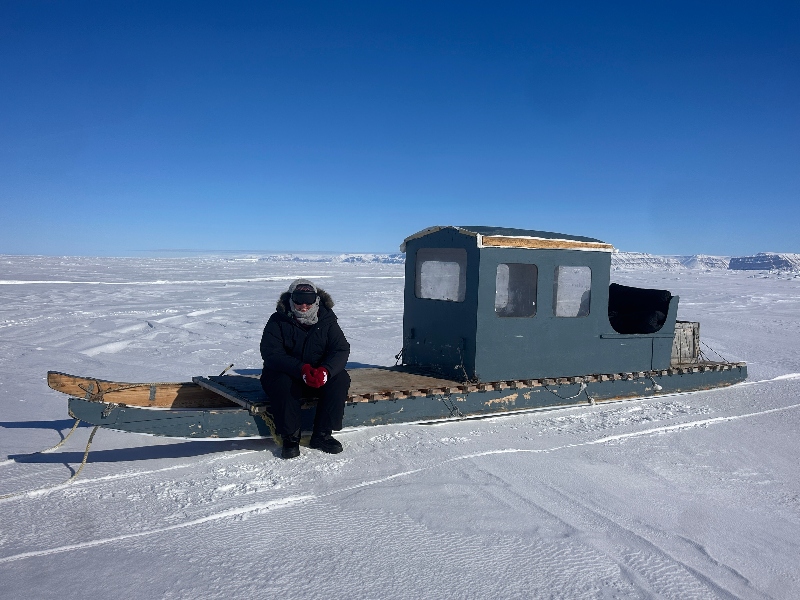 Me and my Qamutiik
At first the cold seems manageable.
Then the skidoo accelerates and Arctic wind immediately finds every microscopic gap in your clothing.
I wore multiple thermal layers, snow pants, a down jacket, heavy outer shell, scarf, beanie, hood and two layers of gloves. It still felt cold.
The brightness was another surprise. Even on cloudy days the ice reflected so much light that goggles became essential. Sunglasses were useless because they fogged up the moment your face covering was pulled into place.
The ride to camp took around 90 minutes across rough sea ice. The qamutiik has absolutely no suspension, so every bump is transmitted directly through your spine. Sitting outside was less jarring but freezing. Sitting inside was warmer but felt slightly like being shaken around in a large plastic storage container.
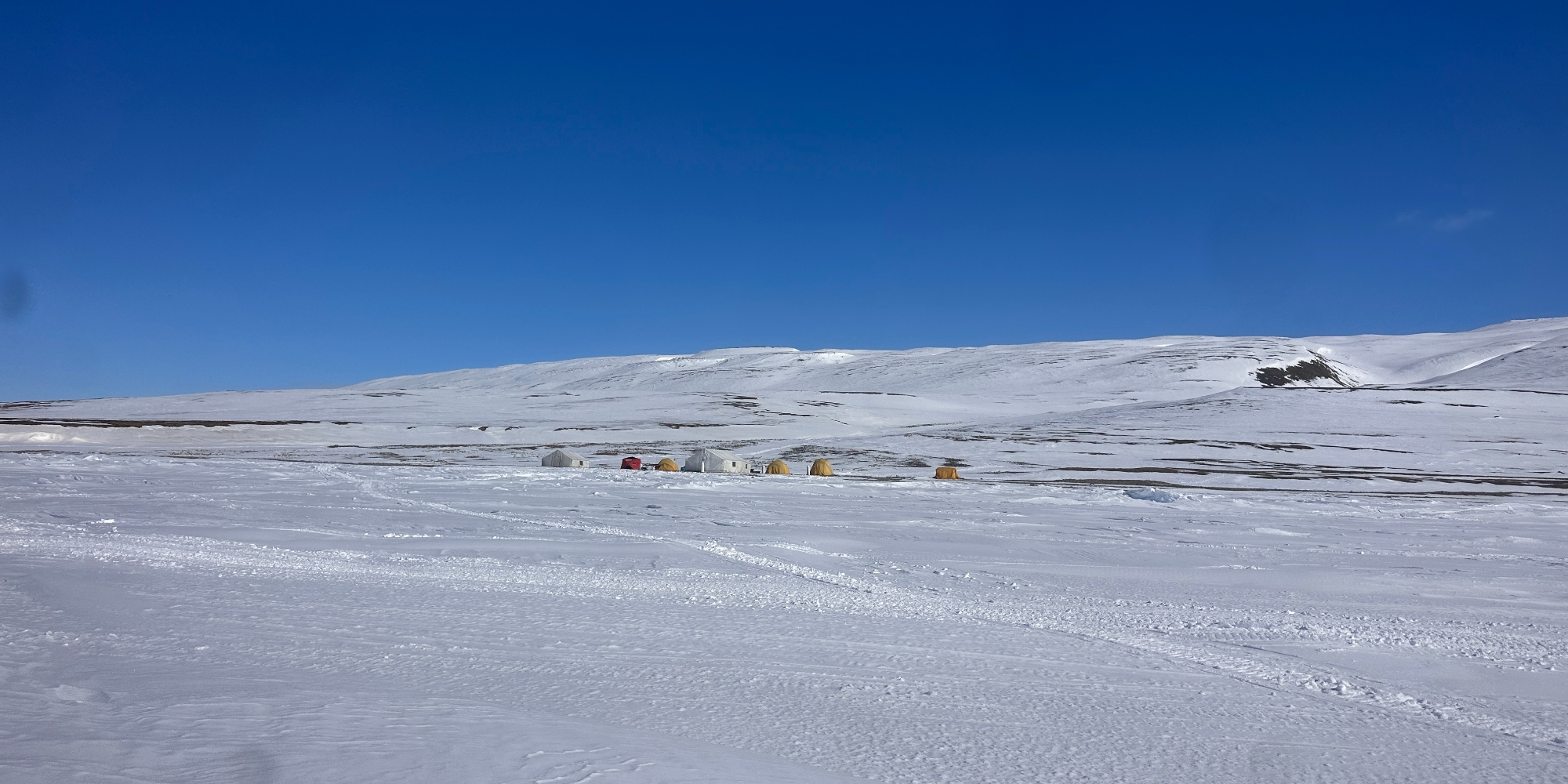
Camp itself was basic but had the essentials: sleeping tents, a kitchen tent and a wash tent.
The toilet situation initially involved a bucket inside a tiny tent so small I couldn’t stand up properly inside it. Thankfully the bucket was moved to a larger tent the next day, which improved my morale considerably.
I had originally expected another guest to join the expedition but in the end, I was the only visitor staying at camp, which made the experience feel even more isolated.
The kitchen tent became the social hub of camp: warm, constantly smelling of coffee and equipped with snacks, gas stoves and surprisingly reliable Starlink Wi-fi. It felt bizarre being able to communicate with home while sitting beside the frozen Arctic sea.

Sila and Kimble in the kitchen tent

The washroom
Meals were basic but hearty: pork and rice, chicken pasta, mince with frozen vegetables and one memorable appearance by Hamburger Helper, which I can confidently say is not for me. Breakfasts, however, were excellent.
The sleeping facilities were Arctic Oven tents with foam mattresses and heavy sleeping bags. Mine also had a propane heater with an uncovered flame and a smell of gas attached to it, so I mostly used it in short bursts. Thankfully the sleeping bags were thick and the tent itself surprisingly cosy.
The constant daylight also took some adjusting to.
The sun never set.
At one point I woke up convinced it was mid morning only to discover it was 12:30am. An eye mask became one of the most valuable things I packed.
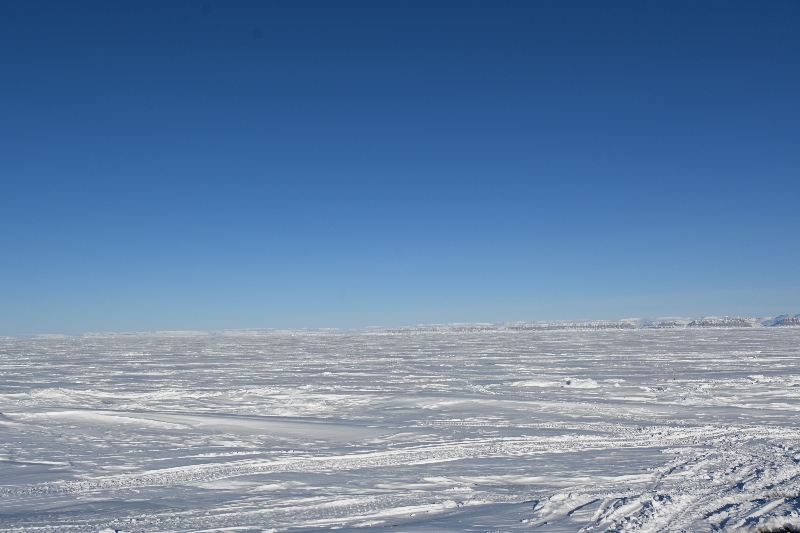 The view from my tent
The other adjustment was the generator. Out on the ice, once the skidoos are turned off, the silence seems to stretch forever, but in camp the constant sound of the generator was impossible to ignore. It took me three days before I stopped hearing it.
What I also hadn’t appreciated beforehand was that a “trip to the floe edge” meant spending eight to 10 hours a day out on the sea ice.
Once you left camp, you were properly out there: travelling for hours by skidoo and qamutiik in sub zero temperatures, completely exposed to the elements for the entire day.
The ice is constantly moving. Cracks appear and close overnight. Wind, tides and currents reshape the landscape every day. The floe edge can be accessible one morning and impossible to reach the next.
Kimble’s understanding of the ice was impressive. He noticed subtle shifts in colour, texture and movement completely invisible to me. Watching him assess cracks, pressure ridges and changing conditions made it obvious that this knowledge comes from generations spent travelling and hunting on the land.
And hunting remains deeply tied to life in Nunavut.
My guides spoke matter of factly about hunting narwhals, seals and polar bears as part of Arctic life and survival traditions. But hearing about wealthy international visitors flying in specifically to shoot a polar bear as a trophy felt entirely different.
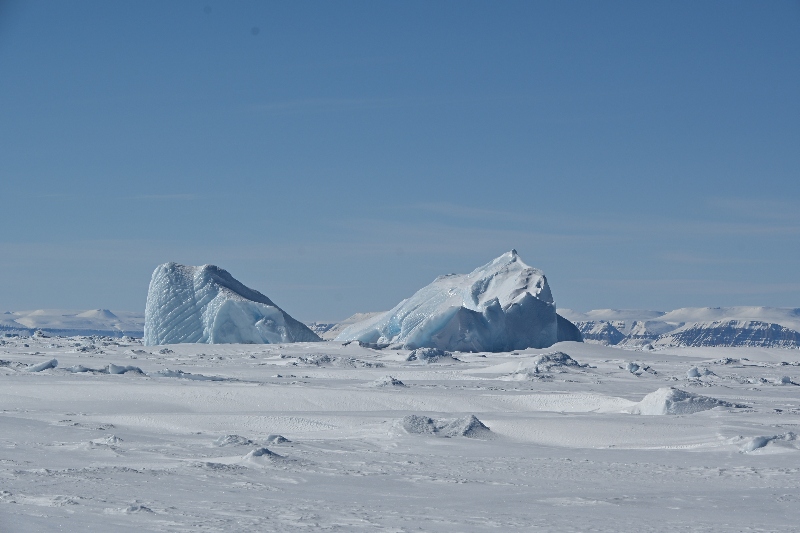
On our first full day travelling toward the floe edge, we encountered another expedition team from Arctic Kingdom, the region’s luxury outfitter.
And proving the adage that wherever you go, there’s always an Aussie, one of their crew members turned out to be Patrick, who grew up in St Ives. It was truly surreal to be standing in one of the most northern places in the world chatting about Sydney.
Arctic Kingdom and Arctic Bay Adventures have a partnership, combining luxury tourism with local Inuit guiding expertise.
The contrast between the two operations was striking.
Arctic Kingdom’s camp looked like a five-star hotel compared to ours. Located directly on the sea ice much closer to the floe edge, it featured impressive guest tents, proper washrooms with running water and showers, plus activities like sea ice kayaking and snorkelling.
Arctic Bay Adventures offers something much rougher around the edges, but also far more intimate and, at around a third of the price of Arctic Kingdom, significantly more accessible.
Both experiences clearly appeal to different travellers.
The Arctic itself, however, remained the real focus.
On our second day we spotted a polar bear moving across the ice.
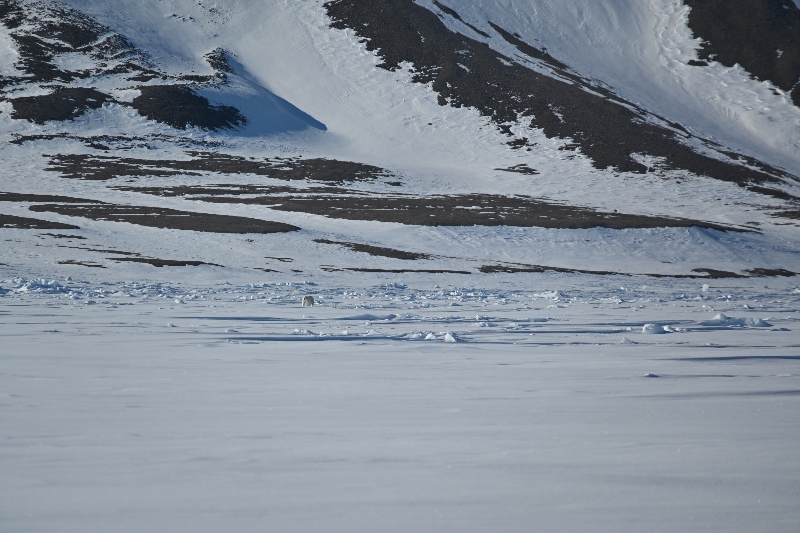 First sighting
At first it appeared as nothing more than a cream coloured speck in the distance. Then suddenly my eyes adjusted and it became unmistakable.
The bear monitor pointed it out to me. It was standing alone on the sea ice somewhere between 500 and 750 metres away, close enough to recognise clearly but still far enough to feel completely untouchable in the scale of the Arctic landscape.
Then everything sped up.
One of the guides jumped on his skidoo and headed towards it, circling behind the bear which immediately sent it running back across the ice in our direction.
We took off after it at full speed.
Even then, “close” in the Arctic is relative. At its nearest the bear was still around 250 metres away, sprinting effortlessly across the sea ice while we bounced behind it on skidoos trying to keep up long enough for photos.
And then, just as quickly, it disappeared back into the landscape and kept running into the distance leaving me praying that my camera had done the encounter justice.
On our last day we finally made it to within 100 metres of the floe edge. Through the one small section of open water visible from where we stopped, a group of beluga whales passed through almost immediately. If that’s what’s visible through a single gap in the ice, it’s hard to imagine what the full floe edge looks like in peak season.
The Arctic is not a static frozen wilderness. Routes change daily. Weather dictates everything. Some days you see wildlife. Some days you simply travel across an endless white landscape trying to understand it.
The Arctic doesn’t care about your itinerary.
You go when the weather allows. You stop when the ice says stop.
And honestly, that was enough.
Did I mention I SAW A POLAR BEAR?