
Australian citizens will be required to have an Electronic Travel Authorisation (ETA) for travel to the UK from Wednesday (February 25).
From that date, Australian citizens who do not already have a UK immigration status (e.g. dual British or Irish nationality), will require an ETA before travelling to the United Kingdom for short stays of up to six months.
The ETA is a pre‑travel authorisation that enables security checks to be completed before departure.
This forms part of the UK’s transition to a more streamlined, digital immigration system which will be quicker and more secure for the millions of people who pass through the UK border each year.
The introduction of ETAs is in line with the approach many other countries – including Australia, New Zealand and the U.S. – have taken to border security and helps prevent the arrival of those who present a threat to the UK.
Australian citizens can apply for an ETA using the UK ETA app or on GOV.UK here
What is an ETA?
The ETA is a requirement for visitors from visa‑exempt countries. It allows the UK to complete checks prior to travel and will be mandatory for citizens of 85 nationalities, including Australians, from February 25.
An ETA currently costs £16 (approx. $AU30) and permits multiple journeys to the UK for stays of up to six months at a time over two years or until the holder’s passport expires, whichever is sooner.
ETAs are also mandatory for visitors who arrive in the UK to take connecting flights and go through passport control.
Who is not eligible for an ETA?
British and Irish citizens, including dual British‑Australians and Irish-Australians, are not eligible to apply for an ETA as they already have rights to live and work in the UK that Australians and other nationals do not.
If you’re a dual citizen with British or Irish citizenship, when you travel to the UK from February 25 you’ll need to enter the UK using either:
# A valid British passport
# A valid Irish passport or
# another valid passport (such as your Australian passport) with a certificate of entitlement.
Without one of these documents, carriers cannot verify they are a British citizen, which may lead to delays or refused boarding.
This is a requirement for all British citizens, regardless of their other nationality, and is the same approach taken by other countries, including Australia, the U.S. and Canada.
https://www.gov.uk/dual-citizenship
Why dual citizens cannot use an ETA
British citizens already have the right of abode in the UK, so they cannot travel under the ETA system.
Irish citizens are also exempt from ETA requirements due to the Common Travel Area (CTA), which provides long‑standing reciprocal arrangements and shared travel area between the UK and Ireland.
More information is available here
From February 25, international carriers must confirm through automated checks that passengers hold valid permission to travel.
When a passenger is identified as a British national, they cannot travel on an ETA and must present a British or Irish passport, or a certificate of entitlement in their valid foreign (Australian) passport.
When you can travel with an expired UK passport
Your carrier (for example your airline) may allow you to travel if you have both:
- An expired UK passport, issued in 1989 or later
- A valid passport for one of the nationalities that can get an electronic travel authorisation (ETA)
The personal details on both passports must match.
It is the carrier’s decision whether to allow you to travel.
If you previously had a UK passport, you can apply for an emergency travel document.
You cannot get an ETA if you’re a British or Irish dual citizen.
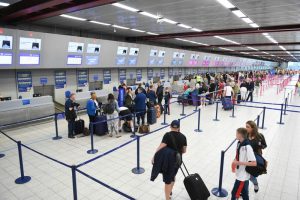 Meanwhile FCM Travel, the large-market corporate division of Flight Centre Travel Group, has released a critical advisory for Australian corporate travellers regarding European border management.
The guidance clarifies confusion surrounding the existing 90-day short-stay rule, the Entry/Exit System (EES), and the upcoming ETIAS pre-travel authorisation
The advisory consolidates official data from the European Commission, the EU’s EES/ETIAS portals, and government sources to help travel managers navigate the changes.
“Executives are travelling to Europe in large numbers – and some are still tripped up by 90/180 calculations, EES biometrics, or when ETIAS actually starts,” said Renos Rologas, FCM Travel General Manager, ANZ.
“These sorts of complexities are our bread and butter – allowing us to navigate the difficulties for customers so they’re freed up to do what they do best. We’re helping travel managers plan correctly by pointing them to the official rules and timelines, so itineraries aren’t derailed.”