I came away from Phu Quoc with a problem.
I had just spent several days exploring Vietnam’s largest island as part of a press trip and I wasn’t entirely sure what to make of it.
Our guide had been given a brief to show us the more authentic side of Phu Quoc and, where possible, avoid the island’s man-made attractions. It made sense. After all, we’d travelled to Vietnam to experience Vietnam.
But in Phu Quoc, I think that approach misses much of what makes the island interesting.
There are certainly authentic experiences to be found. Large areas of Phu Quoc remain protected within its National Park, pepper is still grown by hundreds of local farming families and fish sauce and pearl production remain part of island life.
But modern Phu Quoc is also an island of extraordinary man-made attractions. There are faux Venetian canals, Mediterranean-inspired towns, a cable car soaring across the sea, huge theatrical productions and fireworks exploding over the water every night.
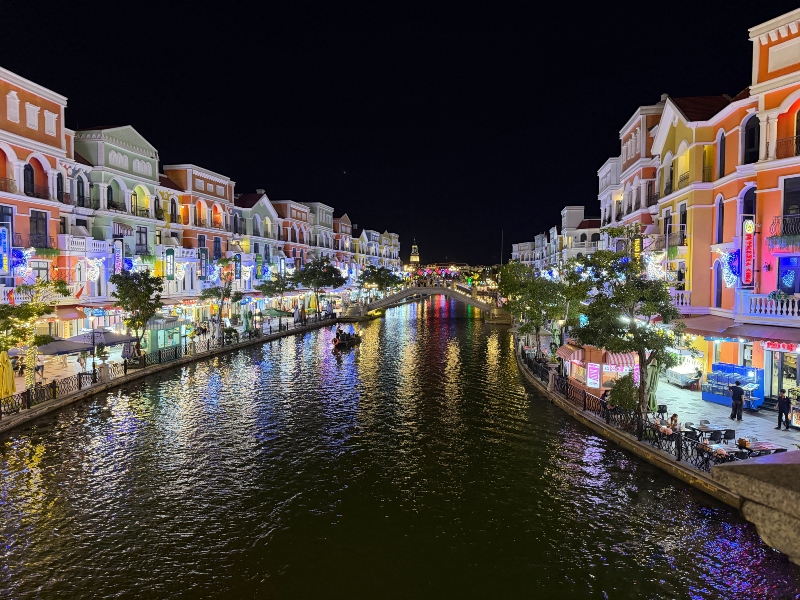 Grand World’s Venice
And rather than trying to avoid those things in search of the “real” Phu Quoc, I came to the conclusion that visitors should probably do the opposite.
Embrace them.
Because increasingly, they are Phu Quoc.
The island itself is changing at extraordinary speed. Vast construction sites sit alongside established resorts, new roads lead through emerging developments and entire streets of newly-built properties appear strangely empty.
With Phu Quoc set to host APEC in 2027, 21 major infrastructure projects are underway, including an expanded international airport, new conference centre, metro, roads and APEC Boulevard.
The Vietnamese Government sees the investment not simply as preparation for the summit but as an opportunity to accelerate the island’s longer term development.
It feels as though Phu Quoc is betting heavily on the philosophy that if you build it, they will come.
And perhaps they will.
For travellers who do want to explore the island’s natural side, there is plenty to find.
Large areas of are protected within Phu Quoc National Park and travellers wanting to get into the island’s interior can explore its forests on foot. Local operator Quang Si offers a four-hour Suoi Tien jungle trek combining an easy forest walk with a swim in the spring.
We didn’t venture into the National Park but did enjoy Suoi Tranh Stream.


After walking through large tropical gardens, complete with some rather interesting sculptures, a path follows the stream towards a waterfall. Along the way we passed local families picnicking on flat rocks beside the water.
When we reached the waterfall, we had it entirely to ourselves and after walking in the tropical heat, a swim was very welcome.
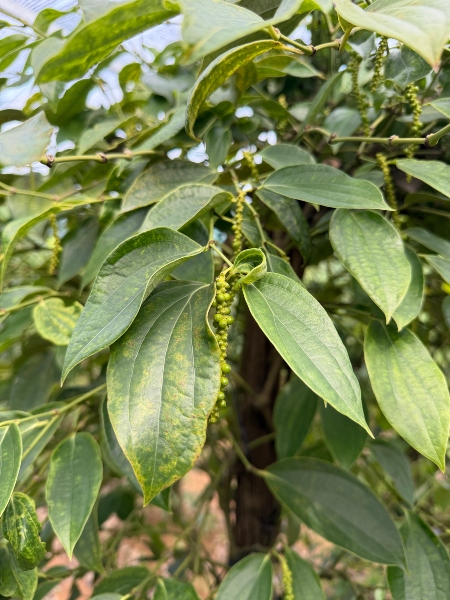 Pepper offers another connection to the island’s traditional way of life. Vietnam is the world’s largest exporter of pepper and hundreds of farming households on Phu Quoc are involved in its production.
Hai Duong Pepper Farm is one working farm where visitors can walk among the vines and learn how the island’s pepper is grown and processed.
For a very different perspective on the island, Phu Quoc Prison, also known as Coconut Tree Prison, offers a sobering insight into its wartime history. Today the former prison is preserved as a historical site, with confronting displays depicting the conditions endured by prisoners.
Not every experience marketed as traditional necessarily delivers, however.
One experience I would be considerably less enthusiastic about repeating was our basket boat trip.
Basket boats are one of those quintessential images of Vietnam and we’d been promised a musical folk experience showcasing the “intangible cultural heritage on the river”, visit the floating market and savour a variety of specialty fruits on the river and engage in fishing activities with local fishermen. I’d been looking forward to it.
What followed was rather different.
We climbed into our round bamboo boats on an extremely quiet stretch of river, travelled perhaps 100 metres downstream and were then treated to a karaoke rap song.
Not quite the traditional Vietnamese music I’d been expecting.
The basket boat demonstration itself was impressive, but the overall experience felt geared more towards generating tips than providing any meaningful insight into Vietnamese culture.
There was no sign of a floating market or fruits and the fishing activity appeared to be our guide pulling up a net and displaying a small prawn!
You know how sometimes a travel experience is so bad that it’s good?
This wasn’t one of them.

Perhaps we’d been trying too hard to find authenticity.
Because Grand World Phu Quoc doesn’t pretend to be authentic at all.
Think faux Venice complete with canals and gondolas, a Teddy Bear Museum, restaurants, shops and entertainment. It’s unapologetically touristy and makes little pretence about being anything else.
So why fight it?
It was also here that we watched The Quintessence of Vietnam, a huge theatrical production drawing on Vietnamese history, traditions and cultural life. With hundreds of dancers, elaborate costumes, music, water effects and a spectacular outdoor setting, it’s tourist entertainment on a grand scale and well worth seeing.

Grand World’s Teddy Bear Museum

The Quintessence of Vietnam
Sunset Town takes the spectacle even further.
The Mediterranean-inspired development in the south looks as though a piece of Europe has been picked up and deposited on a Vietnamese island.
We arrived in time to watch the sun disappear over the Gulf of Thailand and it was lovely. Even the restaurant names can play tricks on you. We ate at Le Sorrento, where anyone expecting pizza, pasta and a bottle of Chianti might have been surprised to find only traditional Vietnamese food on the menu.
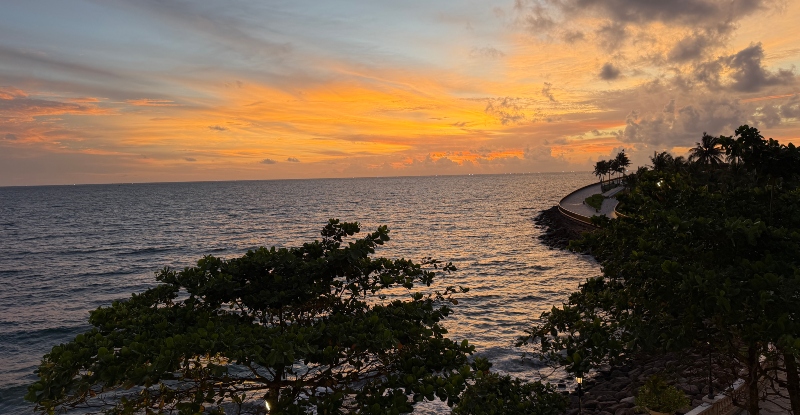
But sunset is really only the beginning.
After dark, Sunset Town becomes a full scale entertainment precinct. Kiss of the Sea combines fire, water, lasers, projections, music and live performers on a huge stage over the sea before finishing with a seven-minute fireworks display.
Nearby, Kiss Bridge consists of two separate arms reaching out over the sea that almost, but don’t quite, meet.
 And then there is the Hon Thom cable car, which carries passengers high above the sea from Phu Quoc to Hon Thom Island.
We didn’t experience either the bridge or cable car, but both would be high on my list if I returned.
This is the Phu Quoc that I think visitors need to be prepared to embrace.
It’s artificial. It’s excessive. It’s very touristy. But increasingly, that’s Phu Quoc.
And rather than spending an entire holiday trying to avoid that side of the island in search of something more authentic, I’d suggest doing the opposite.
Throw yourself into it.
Even our hotel seemed perfectly suited to this new Phu Quoc.
The JW Marriott Phu Quoc Emerald Bay Resort & Spa is built around the wonderfully elaborate but entirely fictional story of Lamarck University, supposedly established on the site in 1880.
Every building, restaurant and detail plays along with the fantasy, from the Department of Zoology to the university’s trophies and memorabilia.
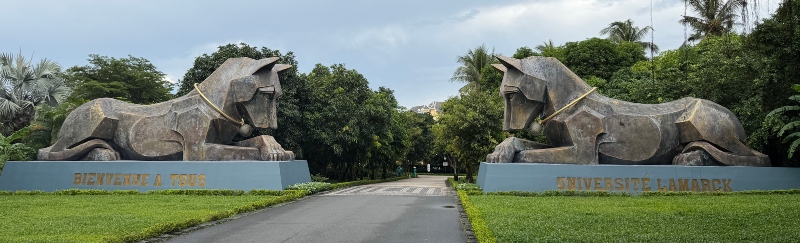
None of it is real. And that’s precisely what makes it so much fun.
Like Grand World and Sunset Town, the JW Marriott doesn’t ask you to believe you’re experiencing traditional Phu Quoc. It creates its own world and invites you to throw yourself into it.
It was one of the highlights of my stay and you can read my full review here.
That’s not to say you should ignore the island’s natural attractions.
We didn’t get the opportunity to experience Phu Quoc’s beaches properly, which seems a significant omission on an island with around 150 kilometres of coastline.
To the south, the An Thoi Archipelago can be explored on boat and speedboat trips, usually combining several islands with swimming and snorkelling. If I returned to Phu Quoc, an island hopping day here would also be high on my list.
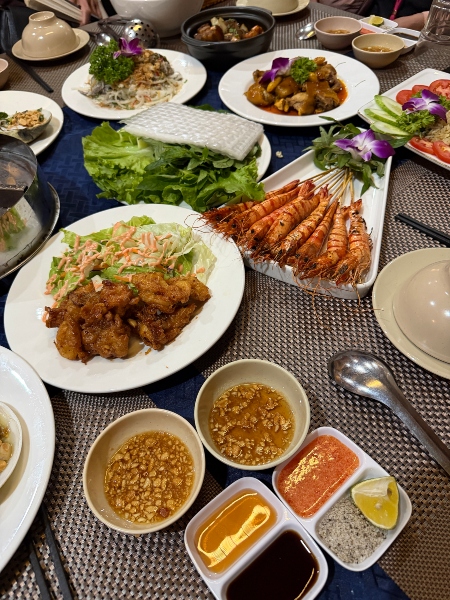 And then there is the food.
We ate at numerous seafood restaurants and, almost without exception, the quality was good. Meals were loaded with fresh herbs and vegetables, seafood was plentiful and flavours were bold without necessarily being spicy.
Phu Quoc is creating a tourism identity all of its own.
Trek through the forest, swim beneath a waterfall, visit a working pepper farm and seek out the parts of traditional island life that remain.
But also ride the cable car. Watch the fireworks. Wander through faux Venice. Take in the spectacle of Sunset Town and don’t worry too much about whether any of it belongs on a Vietnamese island.
Modern Phu Quoc may not always be authentic.
But then again, it’s not trying to be.