There are luxury hotels, there are quirky hotels and then there is the JW Marriott Phu Quoc Emerald Bay Resort & Spa.
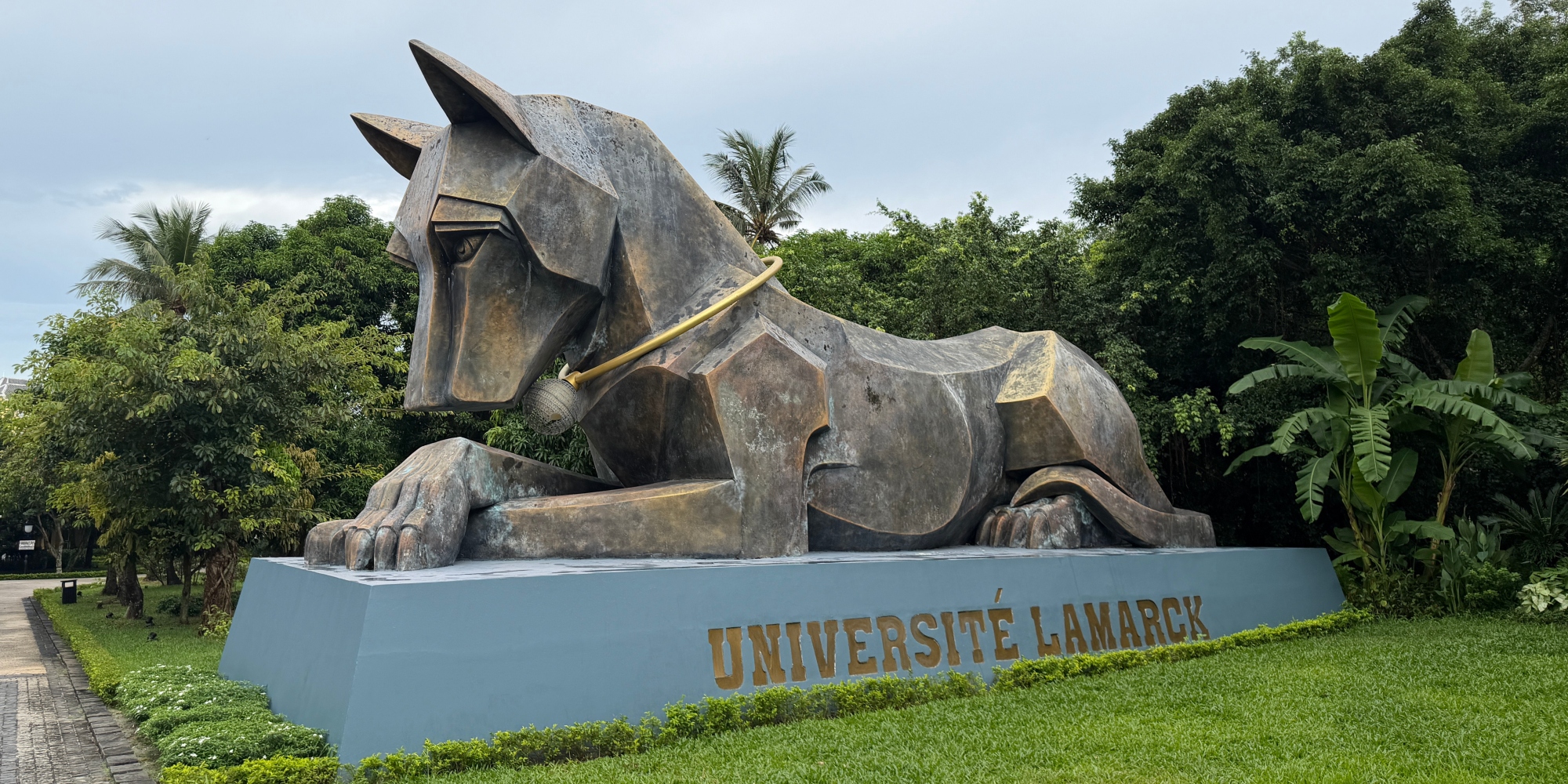
Or, as I came to know it during a four-night stay, Lamarck University.
According to the story, Lamarck University was established in the late 19th century and became one of Phu Quoc’s great seats of learning, educating the children of wealthy Vietnamese families and French colonial residents.
Named in honour of French naturalist Jean-Baptiste Lamarck, its various faculties were dedicated to the study of everything from zoology and chemistry to architecture and mycology.
The university eventually closed, its buildings abandoned and seemingly frozen in time until legendary hotel designer Bill Bensley arrived to transform the forgotten campus into a luxury resort.
Classrooms became guest rooms, university offices became public spaces and the old mycology department found new life as the wonderfully named Chanterelle Spa.
It’s a terrific story.
It’s also completely made up.
There never was a Lamarck University. The JW Marriott Phu Quoc Emerald Bay was built from scratch and opened in 2017 on what had previously been part of a remote fishing village on the southern end of Phu Quoc.
But don’t expect the staff to break character.
The fictional university is not simply a theme applied to a few signs in the lobby. It is the premise upon which the entire sprawling beachfront resort has been created and the deeper you delve into it, the more elaborate the story becomes.
 Designed by Bensley, the resort sits on Khem Beach and its buildings are divided into the various “faculties” of Lamarck University.
I was enrolled, so to speak, in the Zoological Department.
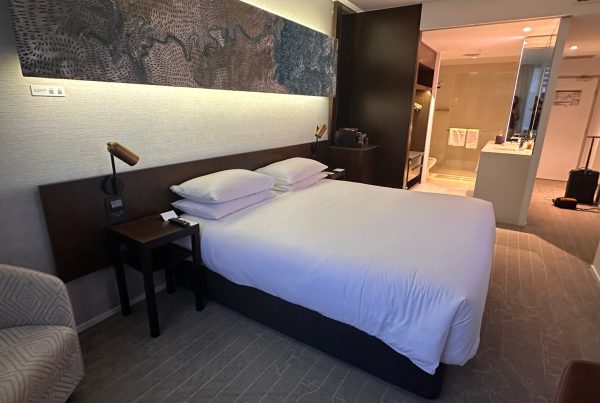
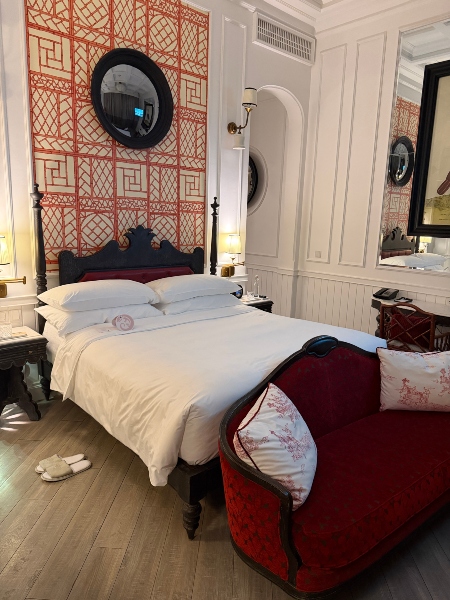 My second-floor room was enormous, with soaring ceilings, an equally enormous king bed and a bathroom with a freestanding bathtub and separate rainfall shower. A balcony ran the width of the room, looking across the gardens and pool towards the ocean.
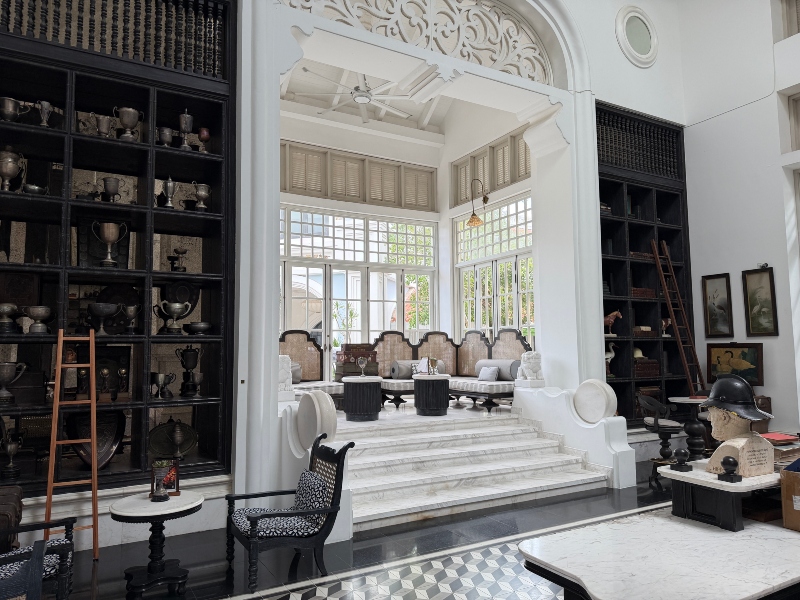
It was luxurious without being remotely conventional. Colour, artwork, vintage-style furniture and seemingly random zoological references were everywhere. Across the resort, Bensley’s eclectic collection of furnishings, curiosities, artwork and architectural details means there is always something else to look at.
Even after four days, I was still noticing things I had somehow missed.
The scale helps. The buildings are huge, the ceilings high and the public spaces generous, yet the gardens, winding paths and Rue de Lamarck give the resort the feeling of a small, eccentric town rather than one enormous hotel.
Rue de Lamarck is also home to a collection of boutiques, including a gallery selling distinctive Vietnamese art and crafts. I left with a collection of lacquer birds unlike anything I’d seen elsewhere on the trip.
Breakfast Worth Getting Up For
Then there is breakfast.
I am prepared to say the buffet breakfast at Tempus Fugit is the best hotel breakfast I have experienced anywhere.
And I’ve eaten a lot of hotel breakfasts.
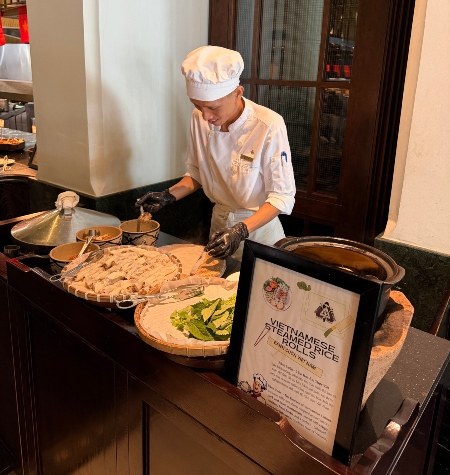
The choice is extraordinary. There are dishes from Vietnam and around the world, multiple live cooking stations and all the breads, pastries, fruit, salads, cereals and hot dishes you would expect from an international five-star hotel – then considerably more.
There is even a dedicated children’s buffet positioned at a lower height so younger guests can help themselves.
But it was the Vietnamese offerings that kept drawing me back. Banh mi, spring rolls and freshly made rice paper rolls competed for space with an impressive coffee menu.
Vietnamese iced coffee? Of course.
 Coconut coffee? Delicious.
Avocado coffee? It tastes, perhaps unsurprisingly, like avocado and coffee – and somehow it works.
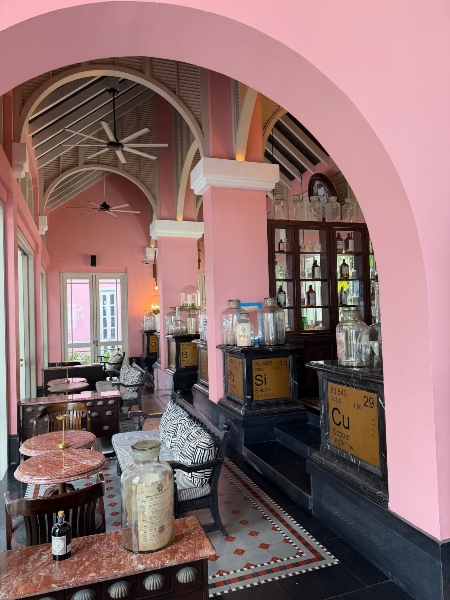
Elsewhere, the dining line-up includes Pink Pearl by Olivier E., the striking pink mansion that is now the resort’s signature French fine-dining restaurant; beachfront Red Rum; French café and bakery French & Co.; and the wonderfully theatrical Department of Chemistry Bar.
 I didn’t have the opportunity to dine in the restaurants during my stay, although I did manage to conduct some fairly thorough research into the resort’s drinks.
Salted coffee and egg coffee at French & Co. were followed on other occasions by cocktails at Red Rum and the Department of Chemistry Bar.
Both bars sit directly overlooking the beach, although the latter wins easily when it comes to theatre, with a laboratory-inspired interior where cocktails are mixed by “chemists”.
Beach Or Pool?
Khem Beach is reason enough to stay put.
During my visit, the sand in front of the resort was almost deserted apart from the occasional hotel guest. The Gulf of Thailand was warm, calm and inviting and the beach never felt crowded.
For those who prefer a pool, the resort has three main beachfront options – Sand Pool, Shell Pool and Sun Pool.
The main pool is huge, with enough different areas to find a quiet corner while still providing decent stretches for anyone wanting to actually swim rather than simply float. There is also an adults-only option.
The fitness centre is similarly impressive: large, modern and well equipped, rather than the token collection of treadmills found in some resorts.
But staying here and doing nothing almost feels like missing the point.
Back To School
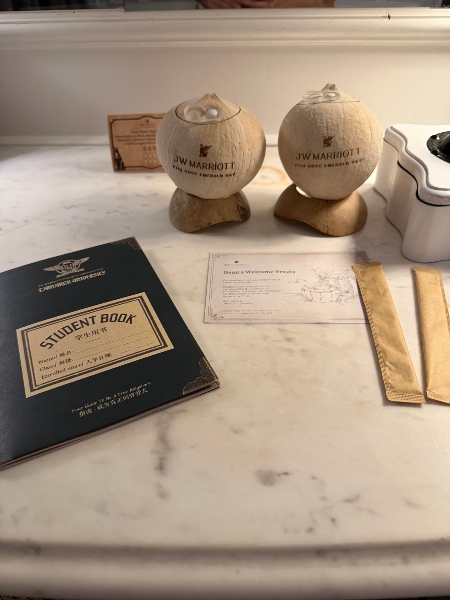 On arrival, guests are given a “student handbook”, complete with the Dean’s Tips and a schedule of activities.
At 6am, for example, students are advised to “Face East to Sunrise”, when the first light hits Emerald Bay.
The daily program reinforces just how family-friendly the resort is, with plenty to keep children occupied and a complimentary kids club, but there is a surprising amount for adults too. Activities during my stay included lacquer making, painting, lantern making, cooking, massage lessons, Zumba and Hatha yoga.
There was even Beer Yoga.
Many activities are complimentary and the resort also offers free kayaking and other beach activities.
It is another clever extension of the university concept: you can quite literally fill your timetable with classes.
And everywhere there are little reminders that you’re supposed to play along.
Among the “Professor’s Secret Notes” in my handbook was one from Bensley explaining his philosophy that a hotel should have a plot, like a movie, worth experiencing more than once.
That philosophy makes sense here.
There are plenty of five-star beach resorts where the ultimate objective is to make the architecture disappear and allow the destination to take centre stage. The JW Marriott Phu Quoc does precisely the opposite.
It wants you to look at it.
It wants you to explore it.
And it very much wants you to believe, at least for a few days, that Lamarck University really existed.
Somehow, it works.
I stayed for four nights and every morning found myself reluctant to leave for our organised touring. By the end of the stay, I still didn’t feel as though I had scratched the surface.
Next time, I’d happily enrol at Lamarck University again.
And I might not leave the campus at all.