Q: Anton, tell us about EcoTraining. What is it and how did it begin?
A: EcoTraining has a special story and a special history which should be understood in terms of the role we play in supporting the bigger ecosystem of tourism in South Africa.
We were born out of Londolozi, a top lodge in South Africa known for its high guiding standards and professional ethics.
We were founded in 1993 in Sabi Sands Game Reserve as an organisation that would then pollinate professional guiding standards into the industry.
So it started 33 years ago – I joined 28 years ago – and we’re humbled to have trained about 17,000 people in 17 countries now.
 Q: Have you ever done anything in Australia?
A: We went to Australia in 2009, set up a camp at Swim Creek Station up near Kakadu National Park and it worked really well. I think we trained a few hundred Indigenous guides.
What we teach is ecological principles and guiding principles, so we always dovetail well with Indigenous culture, because we look at the whole picture of the environment, which is generic throughout the world.
I believe one of the most important issues going forward, as the natural world is under pressure and industry advances, is how do we integrate modern advancement with sustainability?
The nature guide, the safari guide, the naturalist, should have a special place in society in that we are aiming to create a generation of environmentally conscious citizens.
Q: What does your training look like on the ground today?
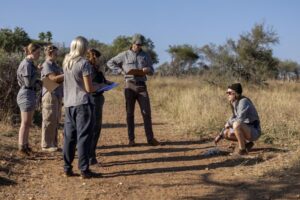
A: We do various forms of training. We have our own camps, where we offer one of 22 different programs.
We also do on-site training, where we train guides at lodges. Over the last few years, we’ve trained about 50 of the top lodge organisations throughout Africa.
We’ve also done a lot of work in different countries, helping set up guiding standards in Jordan and the Middle East, and we’ve worked with the Zoological Society of London training guides in Gabon.
 Picture courtesy Jonathan Roff
Q: You’re now also training what you call “citizen guides”, where ordinary travellers can take a week-long course that teaches them to track, read the bush and interpret ecosystems. What was the thinking behind that move?
A: Training guides, naturalists and university groups means you’re dealing with people who have already chosen their direction. So it’s kind of like preaching to the choir.
We realised if we’re going to impact globally, we need to reach a wider audience.
I don’t believe we live in an era where people want to be preached at or put on guilt trips for their behaviour. People are far more motivated to do things if they are empowered and realise that they themselves have value.
We give people a life‑changing, in‑depth experience, where they feel reconciled as an individual – that’s what nature offers.
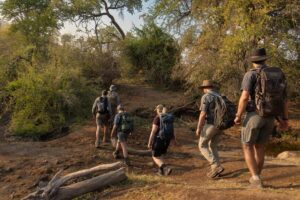
We take you deep into nature, away from all the digital trappings and all the superficial stuff, so you don’t just view nature but experience it on a sensory, psychological, emotional and spiritual level.
Then the heart and mind go through what I call a point of no return. You realise you’re in your natural space. It’s not about the selfie and Instagram; it’s actually about this community we call Mother Nature, planet earth.
Then your motives and your reasoning become different. How you go back and run your company, how you practice your business, how you raise your children – that now comes with a more respectful, holistic view.
The cool thing is, learning about nature and practicing sustainability is a pleasure and it’s enjoyable. So let’s get on with it. It’s not a difficult thing. Plant trees. Recycle. Encouraging the renaissance of nature is an ecological sensation. Just give it a chance.
 Picture courtesy Nicholas Ferreira
Q: Is this something you think more Aussies should get involved in?
A: We have many Australians that come and I think we’re very well suited to the Australian market. Australians are outdoorsy, they’re environmentally conscious and they love Africa.
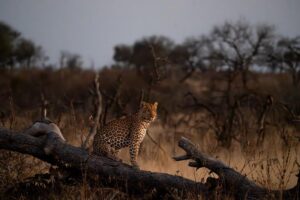
EcoTraining is a natural fit. We are active, we do walks in the bush tracking rhinos and looking at beautiful animals on foot.
We do outdoor lectures that are immersive and not boring and onerous and you get to learn a lot more on a course with us than you will on a normal safari. You get led by experts, you learn more and you experience more.
 Picture courtesy Luca Iltgen
Q: Looking at the bigger picture, you’ve spoken about everyone taking responsibility for their “square metre”. What do you mean by that?
A: There are seven and a half billion people in the world. Seven and a half billion people with awareness, as agents of change, can change the world in our lifetime.
You don’t have to go and save the rainforest. Just start where you are. Imagine if everyone’s empowered to take it on. We as individuals have to do our part and it’ll be won and lost in our square metre.
We’ve only got one planet. Clean water, clean air, clean energy, good relationships, harmony, respect, dignity, symbiosis – it can all be done in our lifetime. It’s a radical thought but it’s an absolute truth.
Q: You’re an inspiring person to talk to but after all these years, do you still get a buzz out of what you’re doing?
A: I’ve often said, and I believe it with all my heart, that if I had 10 lifetimes, I’d dedicate all 10 to this. Firstly, I believe it’s my life calling – it’s never been a job, it’s never been a business.
I’ve also seen how we’ve helped create stability in conservation areas and been part of expanding conservation areas.
How many people have we trained who are now running lodges, running their own safari companies, becoming big, influential people? I believe in the goodness in humankind.
Humankind doesn’t need to save the planet. Humankind needs to understand the rules so that the planet can sustain itself.
Main image courtesy Jonathan Roff
Video courtesy Nicholas Ferreira
For those interested in joining an EcoTraining course, visit: https://www.ecotraining.co.za/contact/