This was the major takeaway from a report on current travel trends delivered by Mastercard economist Katrina Ell at the IMM travel summit in Sydney.
“Australians, we love to travel, we love to go overseas, but we also love to explore our own backyard,” said Ms Ell.
The Mastercard research revealed:
# 30% of Australians plan to go overseas within the next 12 months.
# 14% of Australians plan to spend more than a month overseas.
# 57% of Australians plan to travel domestically. That’s about 13 million people.
“The fact that consumers are really prioritising travel really goes to show how much of a fundamental part of our existence it has become,” added Ms Ell.
“This is a situation that we’ve seen very clearly since the pandemic, that households are overwhelmingly prioritising experiences over buying more stuff.”
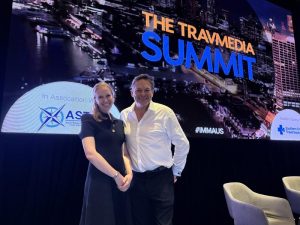 Ms Ell (pictured left with Nick Wayland, CEO, TravMedia) revealed how current currency movements are reshaping destination choices. The U.S. and parts of Western Europe cooled as popular destinations when local currencies strengthened, prompting Australians to pivot to more affordable alternatives or less pricey European cities, such as Warsaw and Krakow.
Bali, the Philippines and Vietnam remain strong draws in Asia, with the latter’s value proposition and lower crowding boosting its appeal.
Medical tourism is another emerging dynamic. Higher domestic healthcare costs have driven Australians to seek dental and other treatments abroad, especially in Thailand, Malaysia, Vietnam and South Korea.
“Even through economic ups and downs, people will continue to seek connection and new experiences. Travel is fundamental,” concluded Ms Ell.
These findings were supported by new research from Southern Cross Travel Insurance (SCTI).
Presenting the Future of Travel study, Jess Strange, Chief Customer Officer at SCTI, said demand was still extremely strong, with Aussies travelling “more than ever” but with far more intentional planning.
“They’re thinking about time, cost and outcome, and are being really intentional about the places they’re going and the decisions that they’re making,” she said.
 According to the SCTI research travellers are increasingly opting for off‑peak seasons to dodge crowds and secure better value, while combining holidays into fewer, bigger trips.
“There’s a lot of combining trips…it might be bigger and a little bit more extravagant, but they’re not jumping on a plane, train or automobile as often as they used to,” Ms Strange explained.
Hesitation factors such as political environment, crime rates, health risks and cost are reshaping destination choices, with the United States, the Middle East and China among the countries travellers feel less inclined to visit.
Despite this, Ms Strange said Australians remain deeply committed to exploring the world.
“They are simply changing the way that they travel and sharpening their focus on value and safety.”
#IMMAUS