The giraffes are nervous.
Like a row of oddly coloured telegraph poles, their necks stand perfectly erect, heads straining to see something moving stealthily in the bush.
This type of discomfort can mean only one thing. Lion.
We’re at the award-winning Samara Karoo Reserve, 27,000 hectares of incredible landscape in South Africa’s Great Karoo region.
 Founded in 1997, Samara has pioneered the rewilding of this area, part of an ambitious plan to create a 400,000 hectare footprint in a Global Biodiversity Hotspot.
It is also striving to achieve a holistic balance of the “4Cs” – Conservation, Community, Culture and Commerce.
“Historically this region was extremely wild. Big migrations used to go through here and we had Cape lion, wild dogs and cheetahs existing here,” says Marnus Ochse, General Manager at Samara, as we chat one morning.
“Over the last century or so a lot of those species disappeared.
“So, when Samara was founded, the big driving force for us was to protect the region’s biodiversity and then secondly to rewild it, bringing a lot of those species back to complete the ecosystem.”
They’ve clearly done a great job so far. The reserve is now home to more than 60 mammal species, including the Big Five, cheetahs, Cape mountain zebra and 225 bird varieties.
The Driving Force
The Samara project is the brainchild of Sarah and Mark Tompkins (*), who saw the potential for making a transformative impact and restoring a landscape that had ‘lost its wildness’.
They started small, buying up one farm in the Graaff-Reinet district and using the knowledge of scientists to see if returning the land to its former glory was even possible.
 “We knew it was lunacy, but we just fell in love with the place,” Mark once commented.
That initial farm eventually became 11 and, after resting the land to recover from its previous use for a decade, the project started to take off.
The Tompkins’ also realised that they needed to bring in income to support their vision so they created a world-class tourism offering alongside the ecological mission.
In turn, this helped create a living for the locals and ensured that by visiting, tourists could support their conservation success story.
 The Game Drive
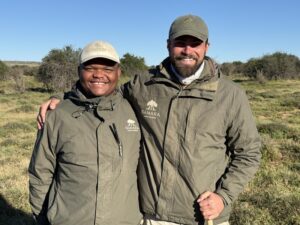
This morning we’re in the capable hands of our highly experienced guide Dom and tracker Dwayne (pictured above) as we head out to see for ourselves just how successful the re-wilding project has been.
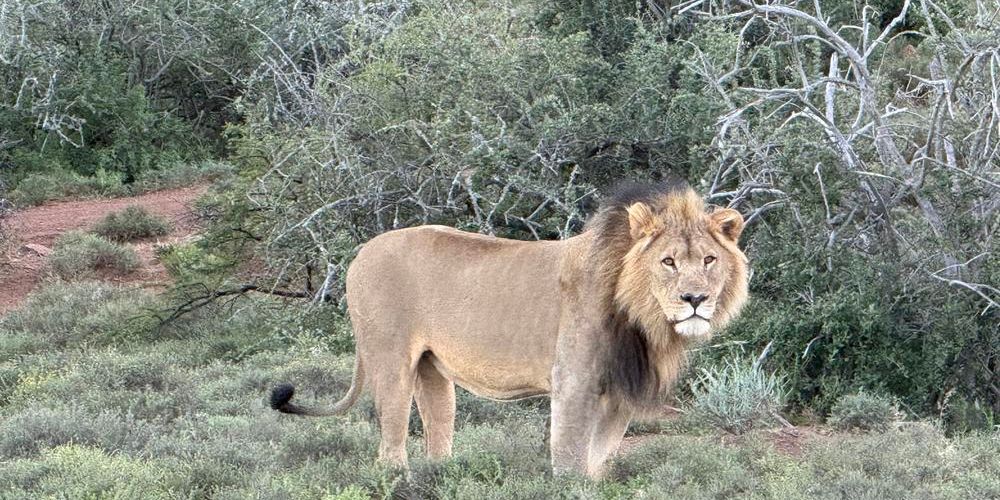
It’s not long before they find the tracks of Shaula, a magnificent five-year-old male lion who appears out of a dry river bed and gives us a look that makes me glad I’m not an antelope…
His is the presence making the giraffes nervous but as he emerges from the thick scrub, giraffe is not on the menu today. He’s marking his territory, using urine as a marker to ward off any would-be competitors (let me tell you, there’s nothing like the smell of fresh lion pee in the morning!).
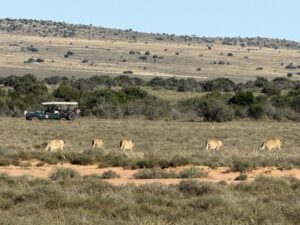
Later, we see a pride of female lions stalking a warthog, eyeing up an early dinner. There’s consternation on the game vehicle as the warthog inexplicably walks toward the approaching danger, a sticky ending on the cards for this particular Pumba.
Fortunately he changes course at the last minute and a noisy, messy, unpleasant denouement is avoided.
While lion encounters are always special, Samara also gets you up close to another of Africa’s most sought-after animals.
A while later we pulled up just metres from a cheetah and her cubs. This is Mbali, a descendant of the original (and famous) Samara cheetah, Sibella. Like her illustrious forebear, she is a fantastic mother and stands guard as her cubs play fight around her.
I’ve done a few safaris in my time but this was as close as I’ve ever got to a relaxed cheetah family…and it was simply spellbinding.
Samara also offers bush walks, allowing guests to track wildlife on foot. This guided experience provides a completely different safari experience.
The Accommodation
As you would probably expect from a five-star game reserve, the accommodation is appropriately lux.
The Karoo Lodge is where the Samara story began and I’m fortunate to be staying in one of the eight Karoo Suites (number six to be precise). A fabulously comfortable and huge bed dominates the main space, with an equally luxurious bathroom tucked behind it.
There’s a complimentary mini-bar with some tempting bottles of adult beverages and a log burning fire that I put to use on a chilly winters night.
Highlight for me was lying in bed of a morning and watching the animals pass by with the spectacular mountain scenery as a backdrop. It doesn’t get more Africa than this!
Apart from the Karoo Lodge there’s also The Manor, a four-suite villa with a fabulous infinity pool, beautiful furniture and fittings, and its own chef. It is designed for exclusive-use bookings and is ideal for groups and families.
For something a little more authentic, the Plains Camp offers a complete cut-off from modern society, with no Wi-Fi, electricity or worldly distractions. From its four deluxe tents, guests can embark on walking tours to track cheetahs, rhinos and lion.
And as if that wasn’t enough, Samara also offers a star-bed, giving guests the opportunity to sleep out under the stars with just nature for company. Think four-poster bed on a raised platform with just the sounds of the Karoo around you.
 The Wonder Plant
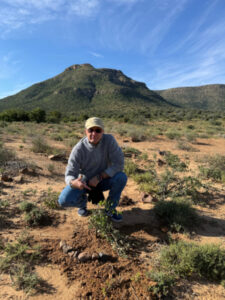
While our animal encounters were remarkable, we also grabbed the chance to plant some Spekboom, a hardy, succulent plant native to South Africa, valued for its ecological, culinary and medicinal benefits.
Known as the ‘wonder plant’, it removes cardon dioxide from the air, can live for up to 200 years and is a favourite of elephants.
Little wonder Samara encourages every guest to plant a tree to help in the rewilding process and boost their conservation efforts. I hope to return one day and see how my little specimen (pictured) is doing…hope it doesn’t end up as lunch!
The Conclusion
Today’s traveller is often looking to reconnect with nature by switching off from the distractions of everyday life. Samara offers that opportunity and much, much more.
As it states in the impressive Kamara brochure: “To immerse yourself in this landscape of infinite horizons is to place everything in your life in perspective once more.”
(*) Sadly Mark Tompkins passed away just days before our visit, aged 85. He was lovingly remembered as a “man of conviction and a true original”.