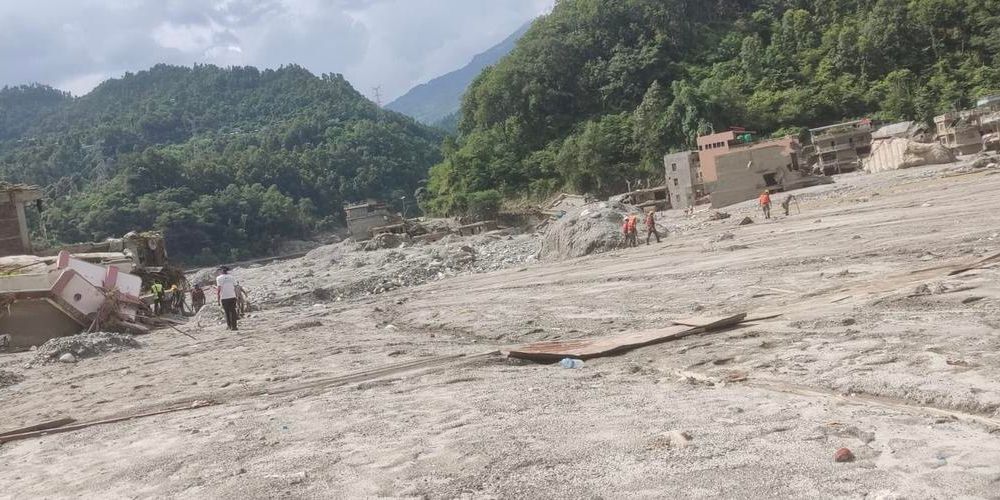
Nepal held a national day of mourning on September 7, 13 days after a glacial collapse sent mud and floodwater through Rasuwa district and across the border into Tibet, writes Nupur Khurana.
More than 1,300 people are confirmed dead and several thousand remain missing. Search teams are still working so none of this should be softened for the sake of a travel story.
The travel trade does, however, need to be precise about where the damage occurred.
The worst-affected areas lie along the Bhote Koshi and Trishuli corridor, particularly in Rasuwa, Nuwakot and Dhading.
The regions behind most of Nepal’s trekking bookings, Everest, Annapurna, Manaslu, Kanchenjunga and Makalu, were not in the path of this event.
The Trekking Agencies’ Association of Nepal (TAAN) has confirmed that Kathmandu, Pokhara, Chitwan and Lumbini remain operational. Trekking permits, TIMS cards and permits for Sagarmatha National Park and the Annapurna Conservation Area continue to be issued.
 The exceptions are Langtang and Gosaikunda, whose routes pass through the affected corridor. Local estimates suggest they may not be workable again until late September.
Access to Kailash through Rasuwagadhi and Kerung is also disrupted. There has been some disruption along a section of the Kathmandu–Pokhara road. Authorities and the army are working to restore access, while domestic flights offer an alternative where required.
Anyone booked on an affected route needs a conversation about changing dates, transfers or itineraries. That is quite different from treating the whole of Nepal as unavailable.
“Of course, postponing a trip is entirely understandable, and each traveller should make the decision that feels right for them,” says Trishank Pradhan from Yeti Holidays based in Kathmandu.
“For those who do decide to travel, however, tourism can provide valuable support at a difficult time.”
For the travel trade, the real issue is the gap between what happened and what the world now believes happened. A flood concentrated in one corridor has become a reason to question travel to mountain ranges that were never touched by it.
Nepal’s tourism minister has estimated flood-related losses at more than NPR 50 billion, or AUD 460 million, including those involving hotels, transport and infrastructure beyond the worst-affected districts. When an entire country is treated as closed, the economic damage travels considerably further than the floodwater did.
The practical response for advisors is simple: check the actual route.
Clients travelling through Langtang, Gosaikunda or the Kailash approach via Rasuwagadhi will need alternatives. For most other itineraries, there is no operational reason to postpone based on the flooding alone.
If a client is nervous, use an actual map to explain the situation rather than the one the news has drawn.
As Pradhan says: “The situation in a few affected areas should not create the impression that the entire country has been impacted.”
Nupur is the AU/NZ Representative, QXP India Travel