As airlines around the world grapple with soaring fuel prices and ongoing economic uncertainty, Vietnam Airlines is taking a markedly different approach to many of its global competitors.
Rather than retreating, cutting services or reducing capacity, the Vietnamese flag carrier is doubling down on growth, investing in new international routes and expanding its presence in Australia – one of its strongest-performing overseas markets.
The strategy comes at a time when the aviation industry is facing one of its most significant cost challenges in recent years.
Rising fuel prices have placed considerable pressure on airline balance sheets globally, forcing many carriers to reassess expansion plans and focus on protecting profitability.
For Vietnam Airlines, however, the challenge extends beyond financial performance.
As the national carrier of one of Asia’s fastest-growing economies, the airline says it has a responsibility to maintain connectivity that supports tourism, trade, education and investment, even during periods of market volatility.
That balancing act – maintaining profitability while continuing to serve national economic interests – is shaping the airline’s response to the current fuel crisis.
 Fuel Costs Create New Challenges
Fuel remains one of the largest operating expenses for any airline and the recent surge in prices has significantly increased costs across the sector.
Vietnam Airlines has responded with a comprehensive strategy designed to maintain operational stability while preserving its long-term growth ambitions.
The carrier has developed contingency plans for a range of fuel price and market scenarios, enabling management to react quickly to changing conditions while minimising disruptions to passengers and operations.
At the same time, the airline has worked closely with financial institutions and commercial partners to protect liquidity and ensure sufficient cash reserves remain available during periods of uncertainty.
Internally, Vietnam Airlines has undertaken extensive cost-optimisation measures, regularly reviewing operational plans and expenditure to identify efficiencies and remove bottlenecks.
The airline has also diversified fuel supply sources and established contingency arrangements to reduce reliance on any single supplier and ensure uninterrupted flight operations.
Rather than viewing the current environment purely as a threat, Vietnam Airlines says the crisis presents an opportunity to strengthen resilience and improve competitiveness for the future.
That confidence is reflected in the carrier’s ambitious outlook. Despite ongoing market volatility, the airline continues to target double-digit growth in 2026 and beyond.
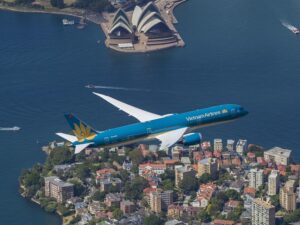 When combined with existing services to Perth, Vietnam Airlines now operates a total of 25 flights per week between Vietnam and Australia.
Australia Takes Centre Stage
A key pillar of that growth strategy is Australia.
Vietnam Airlines has identified Australia as one of its most important international markets, supported by strong demand across several sectors, including leisure travel, international education, business travel and the large visiting friends and relatives (VFR) segment.
Demand between the two countries has continued to grow as Vietnam cements its position as one of Southeast Asia’s most popular tourism destinations while also strengthening economic ties with Australia.
To capitalise on that momentum, Vietnam Airlines has significantly increased capacity on its Australian routes.
Under the airline’s 2026 summer schedule, services between Hanoi and both Sydney and Melbourne have been expanded to four round-trip flights per week.
The additional capacity is designed to accommodate increasing demand, particularly during peak travel periods such as Easter and school holiday seasons.
The frequency boost marks an important milestone for the carrier’s Australian operations and reflects growing confidence in the market’s long-term potential.
When combined with existing services to Perth, Vietnam Airlines now operates a total of 25 flights per week between Vietnam and Australia.
The numbers suggest the strategy is already delivering results.
During the first five months of 2026 alone, the airline carried almost 250,000 passengers on routes linking Vietnam and Australia, underlining the strength of demand and the growing importance of the market within the carrier’s international network.
For Australian travellers, the expanded schedule provides greater flexibility and more convenient connections through the airline’s major hubs in Hanoi and Ho Chi Minh City.
 Aggressive International Expansion
While strengthening its Australian footprint, Vietnam Airlines is simultaneously pursuing one of the most ambitious international expansion programs in its history.
Network growth has become a central component of the carrier’s long-term strategy, helping to diversify revenue streams and increase connectivity across key global markets.
The airline achieved a significant milestone in 2025 with the launch of 14 new international routes, one of the largest network expansions undertaken by the carrier in recent years.
The aggressive growth reflects Vietnam Airlines’ confidence in the continuing recovery of international travel and its belief that demand for Vietnam as both a tourism and business destination will continue to rise.
Expansion not slowing down in 2026
Vietnam Airlines has announced plans to introduce several new international destinations, including Phuket in Thailand, Amsterdam in the Netherlands and Colombo in Sri Lanka.
Each route has been selected to strengthen the carrier’s position in strategically important markets while providing passengers with additional travel options across Asia and Europe.
For Australian travellers, the new routes are expected to create even more opportunities to connect through Vietnam to destinations throughout the airline’s expanding global network.
The additions also reinforce Vietnam Airlines’ ambition to position Hanoi and Ho Chi Minh City as major transit hubs linking Australia with destinations across Southeast Asia, South Asia and Europe.
 Services between Hanoi and both Sydney and Melbourne have been expanded to four return flights per week, effective from April 2026.