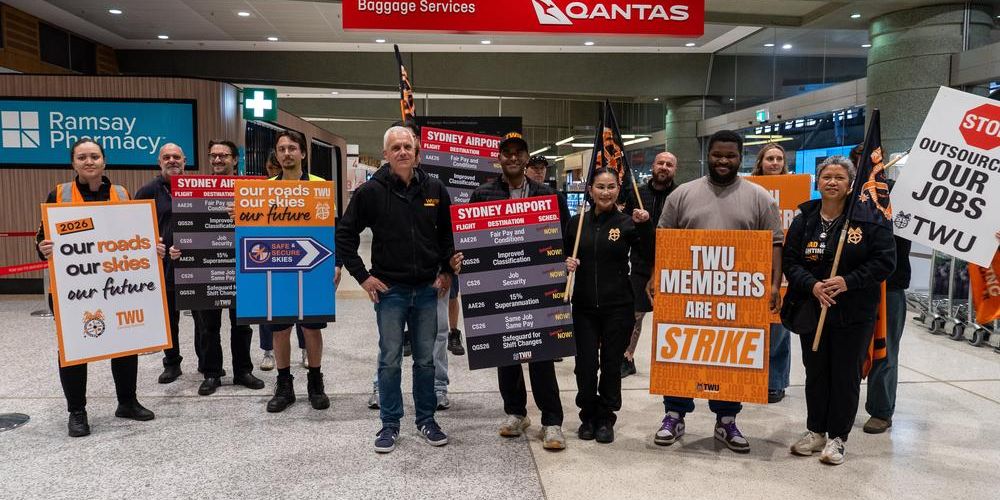
Hundreds of Qantas ground workers have gone on strike across the country in an ongoing dispute with the airline over pay, safety and job security.
The 24-hour action took place at Sydney, Melbourne, Adelaide, Brisbane and Perth airports.
The Transport Workers Union (TWU) say the striking workers represent the last Qantas ground staff left after 1,800 others were illegally outsourced.
According to the TWU, the workers are calling for:
# Fair pay in line with industry standards after a decade of wage suppression
# More full-time jobs and hours
# Workers to be brought back under one Qantas banner to reduce deadly safety failings
In a media statement, the TWU claim Qantas’ scattering of its workforce among multiple subsidiaries has splintered the aviation workforce, draining experience from airports and leading to dangerously unsafe standards for both workers and the travelling public.
“Qantas has tried its best to turn beloved careers into scraps of poorly-paid, unsafe work – but hundreds of ground workers today are striking for better,” said Michael Kaine, TWU National Secretary.
“These workers used to be proud to say they work for the Flying Kangaroo, just as the public used to be proud of this airline.
“But that won’t happen again until Qantas properly invests in its workforce, with pay in line with industry standards, more full-time jobs and an end to workers being pitted against each other in competition.
“It’s time for the new Qantas management to shed the spiteful corporate attitude it inherited from Alan Joyce and actually value workers driving the airline’s billions in profits.”
In response to an inquiry from Traveltalk, Qantas said the industrial action had had little impact on its flights.
“We are aware of planned industrial action by some of our freight and regional workgroups in Sydney and we have contingency plans in place. Importantly there will be no disruption to our customers,” a Qantas spokesperson said.
“We remain committed to reaching agreements with our employees that deliver substantial pay increases and reflect the priorities they have told us are important to them.”