The drive through the Walmer Township in Port Elizabeth is what social commentators would call “confronting”.
One of the oldest townships in South Africa, Walmer has clearly seen better days.
Rubbish lines the streets, roads are deeply potholed and large groups of men stand idly by, hoping to get picked up for casual work.
In an area where unemployment has risen above 40 per cent, it’s hard to imagine anything positive thriving in such a barren environment.
That’s where Jonas Schumacher comes in.
Back in 1998, Jonas came here as an exchange student. He lived in a tin shack as part of the community and simply fell in love with it.
What he did next has been changing lives for more than 20 years.
 A seed is planted
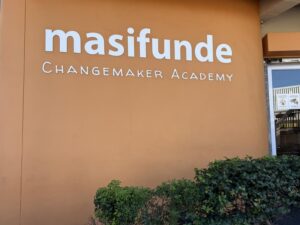
In 2004, Jonas helped set up masifunde, a non-governmental organisation which today runs holistic development programmes for children, youth and adults (aged three to 35).
Apart from the main centre – dubbed the Changemaker Academy – there is a Montessori pre-school for the township children and the kasiConomy hub, a gaggle of shipping containers turned into small business ventures where local entrepreneurs sell hand-made jewellery, art and crafts.
In the Academy, masifunde (which means ‘let us learn’ in Xhosa) provides a range of enriching and educational activities for 450 children and youths, including computer lessons, life skills and talent development in arts, theatre, music and sport.
Their out-of-school programmes also help more than 200 unemployed youths with career guidance, further education, university applications, vocational skills, apprenticeships and entrepreneurial support.
 This award-winning project is now one of South Africa’s most respected non-profit initiatives, with more than 200 schools across the country replicating their interventions and provides guidance and training for local, national and international organisations.
Walking around the centre, the walls are decorated with the artworks created by some of those (the staff call them “beneficiaries”) who have been lucky enough to come here.
Amid such squalor and depression, you might have expected the paintings to be dark and troubling, a reflection of the issues affecting the local area.
On the contrary, they are visions of hope, happiness and security. Children showing the resilience to ignore the physicality of their surroundings and just be kids.
The man behind the mission
I’m fortunate that on the day we visit the centre, the man who started the whole project is in attendance, supervising and looking over the small garden that has just been built at the back of the centre…to his design.
As we chat among the spinach, cabbage and carrots that are blossoming in somewhat difficult conditions, I ask Jonas what prompted him to set up masifunde in the first place.
“I went back to study in Germany, but I always came back to South Africa and to this particular community. My heart just stayed in this community.
“In 2003 we had an opportunity to enrol children from this township in good schools -in the former whites-only schools – and it grew from there.
“We added more programs, we added more children and we professionalised in 2009 when we registered as a non-profit organisation. It just never stopped growing because there was always a need.”
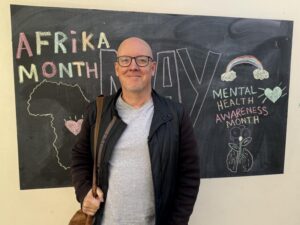 Our delightful guide, Phelelani, was one of those who needed the help of masifunde back in the day, just one of the many success stories over the past two decades.
“We’ve been doing this for 20 years so we’ve have a lot of kids come back,” Jonas (above) explains.
“We have a neurosurgeon who studied in Stellenbosch, we have lawyers, we have teachers at private schools who are the first black teachers there, so some really beautiful success stories.”
But it’s not only the successes that inspire Jonas. It’s also the chance he’s giving people from Walmer to improve their life.
“I just did an interview with a lady who lives in a shack in an informal settlement, just behind the graveyard. She was shaking, just from the opportunity of maybe getting a minimum wage job here.
“Just to be able to give someone that income ability feels great.”
When I ask Jonas how proud he is of what he’s achieved here, he deflects the praise almost immediately.
“It’s not about myself but about the community and how, as an organisation, we have pulled through.
“It’s not an easy community around here, as you will have seen. There are a lot of challenges and a lot of negative pull factors.
“The people here love what they do and there’s great positivity, but it’s still HR management at times and you still have uncomfortable decisions to make.”
 As our time comes to an end, I ask Jonas what he hopes the legacy of masifunde will be.
“This whole thing is called Changemaker Academy, so the vision is that people can make the right changes in their lives.
“Once you make the right changes in your own life, you can contribute to the changes in your neighbourhood. That could be your own children, your family, your community. That’s what it’s all about.
“So small changes for the beneficiaries to just have a have a better life.”
Learning from the Changemakers
By happy coincidence our visit ends just as the children are leaving the pre-school and they pour out of the doors for some much-needed playtime.
We cross the road to say hello and are greeted by waves, giggles and smiles as big as the ocean. It’s such an uplifting, joyous moment that many in our group are misty-eyed as we say our fond farewells.
 As we climb back on the bus and leave Walmer behind, the township looks much the same as it did when we arrived. The potholes are still there, the rubbish still lines the streets and the challenges facing this community remain immense.
But something has changed.
Perhaps it is the realisation that behind the corrugated iron walls of the shanty houses are children dreaming of becoming doctors, lawyers and teachers.
Perhaps it is seeing first-hand that one person’s decision to return to a community he fell in love with has helped thousands believe that a different future is possible.
For 20 years, masifunde has been planting seeds of hope and judging by the smiles on the faces of its youngest changemakers, those seeds are continuing to grow into something remarkable.
In a place where it would be easy to focus only on hardship, perhaps the greatest lesson Walmer offers is this: changing the world does not always start with grand gestures.
Sometimes it begins with one person, one community and the simple belief that every child deserves the chance of a better life.